Performance competition with Will Ormes
Zero angles, factory ammo & performance training
Phil and Will Ormes on what actually separates a performance shooter from an advanced one — not the badge, the bullet count. Three persistent myths, one bullet, one barrel, and the honest answer to why a $4,000 brand-name mistake will still cost you the stage.
- Recorded
- January 31, 2026
- Runtime
- 1:45:54
- Guest
- Will Ormes · @covertnoob5
- Theme
- Performance Competition
On the mic

Before 5 a.m. PST
Cruel and unusual punishment.
Will Ormes joined the call before 5:00 a.m. California time. "Cruel and unusual punishment, to be honest." Phil reminded him it was nothing compared to NRL Hunter Alaska — finishing a stage at 10 p.m., an hour-and-a-half drive back to the Airbnb, blackout blinds against the never-quite-dark sky, then a 7 a.m. start the next morning. "Pro tip," Will said. "Stay as close to the venue as possible."
That's the warm-up. What's underneath it is the conversation The Cadre keeps coming back to with shooters who are good enough to know they're not great yet: what does "performance" actually mean, and what stops most people from getting there. Below the small talk — three myths Will sees at every local match, one bullet thesis, and an honest answer about who you should and shouldn't pay for a class.
Episode
005
Second pass at the topic. Phil's been running The Cadre's performance competition track for two seasons; Will is the kind of shooter that course is built for.
Theme
Performance Competition
Not fundamentals. Not "advanced." The next plateau — what to look for in an instructor, what to stop spending money on, and what 1% edges actually move the needle.
Guest
Will Ormes
@covertnoob5 on Instagram and YouTube. PRS competitor, content creator, and — per Phil — "one of the most underrated voices in precision rifle content."
Runtime
1:45:54
"Hopefully you have some time blocked off — at the reloading bench or on a car drive." Long episode by design. The conversation needed the room.
The myths audit
Three things you'll hear at your local match.
The throughline of the episode is misinformation — what new and mid-pack shooters are picking up from sales counters, YouTube comments, and Instagram clips, and how it's holding them at a plateau. Each myth below is something Will has heard verbatim at a local match in the last six months. The “What's actually going on” line is the answer Phil and Will reached together.
Myth 1
Zero at 200 yards if you never shoot 100-yard targets
What you'll hear
It comes up as a literal range question — a guy walked up to Will the other day and asked, straight out: "Why don't we zero at 200 yards if we never shoot 100-yard targets?" Same advice you'll get from the salesman at Turners or the range officer who means well but doesn't shoot matches.
What's actually going on
"Your setup isn't good enough to shoot at 200 yards and zero at 200 yards consistently. Your scope's not good enough. And you're sure as [shit] not a good enough shooter to have a consistent zero at 200 yards." — Will. Two things fight you. First, holding a 200-yard zero takes a rifle, an optic, and a shooter all repeatable enough to put rounds in the same spot at distance — most setups aren't, and most shooters aren't. Second, wind corrupts a distant zero. Will points out he picks up wind drift at 100 yards in a 10 mph Wyoming breeze — "my zero right now with this wind is a tenth" — so he leaves it. Push the zero to 200 and that drift compounds. A 100-yard zero hides far less of that error than a distant one.
The twist
The interesting wrinkle: Phil is watching top-tier guys — Austin and Clay among them — running Hornady's zero-angle feature established at distance, not at 100. The reason is competition-specific: Hornady gives a firing solution to the hundredth, and on a target only 0.2 mil wide, Phil wants to know whether to round his dial up or down. Different idea, same goal. Watch his channel for the comparison.
Myth 2
You should true your BC before your first season
What you'll hear
A great Francis Colón / MDT video on dual-Garmin BC trueing made the round of every Instagram feed. Suddenly everyone at the local match wants to true.
What's actually going on
"You're trying to take steps five, six, and seven before steps one through four." Will isn't saying don't true — he's saying earn it first. Before you touch it you need three things: know how to do it properly and effectively, know what trueing is actually changing ballistics-wise (you're adjusting the model to match what the bullet really does, not "fixing" the rifle), and respect that trueing has rules of its own. It's lot-by-lot and barrel-by-barrel, over the life of the barrel. New lot? Re-true. Same lot, 2,000 rounds in? Re-true — Will promises the numbers don't stay consistent as the barrel wears.
The twist
Trueing is for shooters whose fundamentals already give them a baseline. If you can't shoot the difference between factory ammo and handloads, you definitely can't shoot the difference a 0.01 G7 adjustment makes.
Myth 3
Buy the gun the brand told you to buy
What you'll hear
Will recommended his buddy start with a Tikka T1x A1 in 6.5 Creedmoor and 140 ELD-M factory ammo. He went out and bought a Christensen and Sellier & Bellot.
What's actually going on
"You couldn't pay me to shoot one. You gave me $10,000 a year, I still wouldn't shoot your [expletive] gun. Your guns are ass." Will made him sit in timeout for an hour rather than waste a practice day. Three or four local matches and a bag of strapped-on weights later — groups still printing like a shotgun on the zero line — the buddy gave up. But here's the part Will keeps hammering: the buddy skipped every incremental step. No Tikka, no Ruger, no Bergara. He jumped straight to full custom, then switched to a 6mm — and Will steered him to a Dasher over a 6 Creed because a Dasher is the easy button, forgiving enough to absorb a new reloader's mistakes.
The twist
Will is blunt that the barrier to entry is NOT real — he doesn't want to scare anyone off, and he got into a comment-thread argument on an MDT post calling a guy an idiot for using "barrier to entry" as an excuse ("that's just a fucking excuse"). You don't need $4,000. Throw a Tikka barreled action in a KRG Bravo or MDT XRS, run 6.5 Creedmoor factory ammo, and you're at the line. Not a championship setup — but more than enough to shoot a match. The only real barrier is being too scared to enter one.
Be afraid of the guy with one bullet.
On the range
What a practice day looks like.
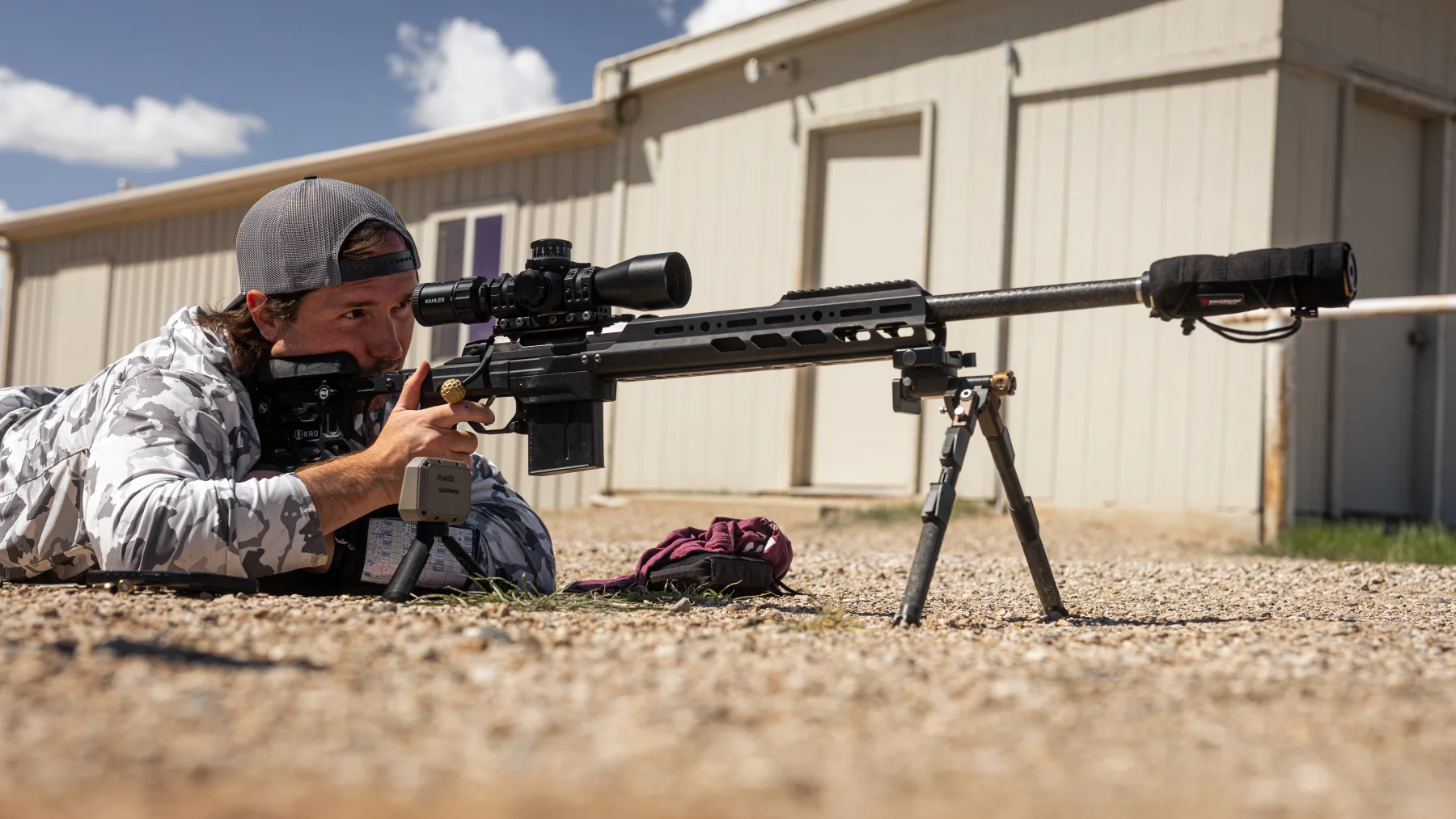
Phil pressed Will on the one thing every “performance” conversation skips: what do you literally do at the range? This is Will's regular session — not a match, not a class, just a few hours with a borrowed barricade. It's the most copyable thing in the episode.
Round count
60–70
For a regular few-hour session. Enough to work, not so much that the day turns into a grind.
Strings
6 shots
Six-shot strings so the barrel cools between runs — and so there's time to mentally debrief each string before the next.
Timer
Kestrel 5700
In the bag every time. Par set so the beep stops being adrenaline and starts being background.
Par time
~50s
Three targets, two shots each. A little under 10 seconds per position — pace for a 10-position stage.
The order never changes. Confirm zero at 100, confirm trajectory from prone or the bench, get a little warm-up in. Then out comes the matchbook — either the last match or one of the old ones that really stung — and Will recreates a stage he bombed as best he can. The baseline he always runs to stay un-rusty is his one-shot drill: port-arms, mag in, bolt back, standing, beep, build the position, send it. At Angeles the smallest target on the range is an 8-inch swinger at 600, so that's the only thing he shoots. He skips everything in between — at that range the mid-distance targets are just too big to teach him anything.
The barricade is the part everyone misses. He borrows one that's deliberately ass — two feet, no tie-downs, no reinforcement, lopsided 2x4s, creaking, flexing back and forth. His buddies hate it. He loves it. "If you can shoot off this thing, you can shoot off anything." A prop that wobbles on purpose is how he keeps his recoil management honest when nothing else on the range will.
What counts as a good position
Phil asked Will to define it in plain, checkable terms — not feel, not vibes. Here's the exact standard he holds himself to, in order, every position.
- 01
Wobble stays inside the plate
If the reticle leaves the plate, get off the prop and find out why — don't break the shot anyway. On that wobbly barricade, if Will can hold an 8-inch plate at 600, he can hold almost any PRS target standing or kneeling.
- 02
The wobble moves consistently
He doesn't love the phrase 'time your shot,' but the honest version is: he wants the wobble in a repeatable motion so he can break it where he intends. The leftover movement is mechanical prop wobble, not shooter wobble.
- 03
Break at the bottom of the exhale
Two-stage trigger, take up the slack, break at the bottom of the breath — the natural respiratory pause. It's there for position one. By positions 6 through 10, as the heart rate climbs, that pause is basically gone and the window shrinks. Plan for it.
The thesis
One bullet. One barrel.
Phil spent 2022 and 2023 chasing data instead of building intuition. Train with 147s because they were cheap; match with 153 A-Tips because they were better; arrive on stage with no feel for either, both hands on the ballistic solver. Look at his finishes those seasons. They went the way you'd expect.
2024 was a different agreement: one bullet through this rifle, all year. 153 A-Tips, 6.5 Creedmoor, regional schedule only. That's the season he started winning. Not because the cartridge changed. Because the audible got easier — call a splash, read the gap, adjust without thinking. By stage four his hand wasn't reaching for the Kestrel.
Will's version of the same lesson sounds like this: "Find a charge weight, stuff the bullet, and shoot the life of the barrel with that speed. Learn that bullet inside and out. If you don't know your dope like the back of your hand, I don't want to hear it."
"One bullet" only helps if it's the right bullet, so Will is specific. In 6.5 Creedmoor the default is Hornady's 140 ELD-M — and if your rifle won't put that in 3/4 to 1/2 MOA, "you have a gun problem." If you can spend more, the Berger 140 hybrid is better: Lapua brass, Vihtavuori powder, "basically a handload" — and you keep the Lapua brass to reload later. In .308 it's the 168 or 175 Sierra Match King; if your gun won't shoot that, throw the gun away. What he won't touch is factory 6GT or 6mm — "dog water," huge SDs and ES. If you're set on a 6, reload it instead.
Phil's sniper dope makes the same point from the other direction. The numbers he memorized cold — 600 yards is 4.4 — were all built on a 175 SMK at 2,643 fps in standard atmosphere. He didn't know his G7 BC or his charge weight back then. He just knew the bullet, because it never changed. That's the whole game: one bullet, learned to the back of your hand.
The hardest part of this advice isn't doing it. It's resisting the next shiny cartridge. Phil openly told the new shooter who asked him why he runs so many calibers: "Don't do what I do. I am the worst example of that."
- Unstable position — reticle wobbles off the plate
- Couldn't find the target / lost the target order, timed out
- Forgot to hold wind — ten rounds in the same empty spot
- Decent factory ammo vs. a handload
0–500
Gear check at 100
Don't leave 100 yards. You're not training trajectory — you're confirming the rifle, the optic, and the position are all doing what you think they are. For the foundation class, Phil rarely leaves 100 on day one. He's done it on performance-competition day one too, because guys think they're better than they are.
500 to barrel out
One bullet, one process
Same lot of factory ammo — buy the whole barrel life of it up front (3,000–4,000 rounds on a 6.5 Creedmoor with 140s, depending on how hard you run it and what barrel you have). Same charge weight if you reload. Build your part-time on a one-shot drill out to the longest target you can reach. Learn what THIS bullet does cold, hot, dirty, and clean.
Barrel halfway
Audible your way through it
By now you know your dope like the back of your hand. You can call corrections from splash without reaching for the solver. The barrel is teaching you what it does as it wears — and your trued data drifts with it, so read it instead of fighting it.
Barrel 2
Same caliber. Different barrel.
Two barrels minimum before you change calibers. The first barrel establishes your baseline — cleaning cadence, how BC drifts as it wears. The second either reinforces it or proves every barrel has its own personality, like tires you replace. Either lesson beats switching to a hotter cartridge at 1,500 rounds.
Round counts are guidance, not gospel. The point is the sequence — gear check, intuition, audible, then prove it on a second barrel before you change the variable.
Below the line
What “performance” actually means.
The roadmap above is the easy half. The harder half is what you choose to think about while you're behind the gun. Three habits the episode lands on — none of them gear, all of them free.
Film yourself, even badly.
Will posted a stage from his most recent match. The first shot was an impact the ROs didn't call. Solo dropped into the comments: "Your recoil is different on every shot." Looking back at it, Will agreed — sometimes four mils high, sometimes near zero, sometimes diagonal. In the middle of a two-minute stage you don't catch any of it. A week later, on tape, it's obvious. That's not a trigger-cam-only insight. A phone on a cheap tripod is enough.
Talk to yourself out loud.
This is the one Will swore by for local matches. When the timer beeps and the wind call is wrong, he says "more wind" out loud to nobody but himself. Saying it ties the next shot to the correction. New shooters routinely dump ten rounds in the same spot because they forget to hold wind at all — the verbal cue stops the spiral before it starts.
Train with a real shot timer.
Not a phone with someone yelling "go." An actual shot timer, dry-fired at home, live at the range, in the bag at every match. Will is honest that it isn't a one-to-one substitute for match pressure — ten guys watching and an RO scoring you is its own thing — but it normalizes the beep so it stops turning your brain to mush. He even brings his own to locals and refuses the phone: "I want to hear the beep, not you say go — and the beep at the end too." That's the path from "my brain turns to mush when the beep goes off" to running par times as an average part of the workflow.
And — about the instructor question.
Will's bar has two parts. First, a real, pre-built curriculum — something with homework you can take home and keep practicing. He's paid for the other kind: get out there, hop on a prop, and the instructor freestyles, "I'll just unfuck you as you go." His verdict — "that's just my average practice day. I don't know why I'm paying to be here."
Second, some skin in the game. He wrestles with it honestly, because the best coaches in pro sports were often poor players — Phil Jackson was below average, Belichick never played in the NFL, same story with Saban — so he won't demand the current golden-bullet winner. But he lands here: "How can you teach me about competition if you don't compete?" You'd at least have to be a competitor. Phil's version is the same test from the other side: have a real curriculum, and know when to deviate from it for the shooter in front of you.
You're not good enough to shoot the difference. I promise you.
Closing
The plateau isn't a gear problem.
The shortest version of an hour and forty-five minutes: most of what holds a mid-pack shooter at mid-pack isn't the rifle, the optic, or the cartridge. It's the willingness to stop chasing variables. One bullet through a barrel. One process behind the gun. A timer that's there every time. A camera pointed at yourself even when the footage embarrasses you.
None of that is sexy. None of it is on a shelf at Turners. It's the work that compounds while you sleep — and the thing that quietly separates the guys who say they want to compete at a high level from the guys who actually will.
Train with us
The work behind the talk.
Phil's performance competition track exists for the shooter this episode is about. If you're past fundamentals and stuck at a plateau, that's the room. Same instructors, same standard, on the range with you.