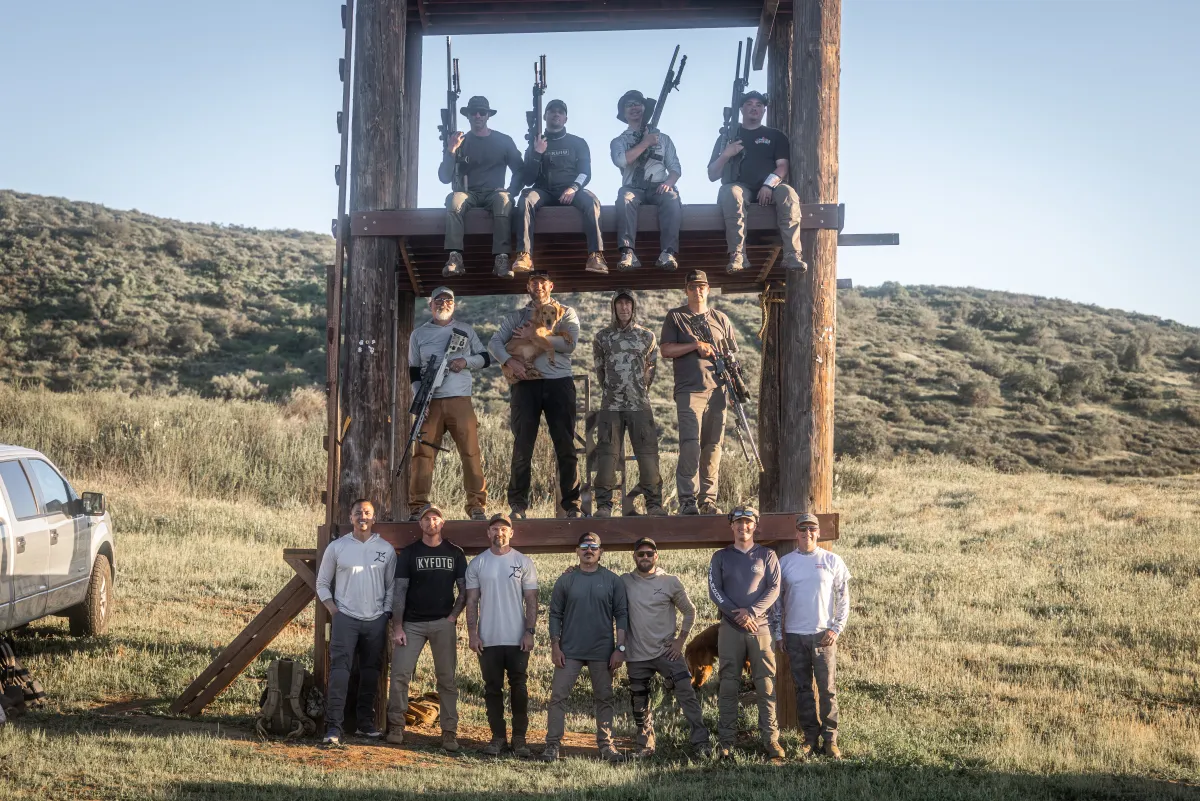
Level 2 · Three-day course
Advanced
Build the position. Read the wind. Own the shot.
- Level
- Level 2
- Length
- 3 days
- Prerequisite
- Foundation or equivalent
- Tuition
- from $1,000
What to expect
Three days. One measured progression.
Advanced is where a solid prone shooter learns to solve the rest of the range. Over three days, you will build repeatable tripod and adaptive positions, sharpen your wind and ballistics process, and prove it all through scored known- and unknown-distance engagements.
- Targets per scored engagement
- 5
- Points on the Cadre scoring system
- 20
- Yards for core KD / UKD courses
- 300–700
- Instructor wind calls during assessment
- 0
Who it's for
Foundation built. Time to leave prone.
Advanced is for Foundation graduates or shooters with an equivalent command of rifle setup, zero, data, and a repeatable prone shot process. We assume you can operate the rifle safely and keep your mechanics together while you solve a basic engagement.
This is the bridge from a clean prone hit to a complete field solution. The target may be unknown, the wind call is yours, and the terrain decides the position. We give you a process for each variable, then score the result.
Day by day
How the course runs.
Advanced is built as a loop: establish the baseline, learn the system, apply it under pressure, then run the same standard again. The score makes the improvement visible, and makes the next weakness impossible to hide.
Day 1 The tripod and the wobble zone
7 blocks
Validate the rifle, establish a scored baseline, then build the four benchmark tripod positions from the ground up.
The baseline score is not a verdict. It is the entry point for your progression.
You'll learn to see the reticle's movement as information: separate lateral, horizontal, mechanical, and wind-induced wobble, identify the cause of each, and choose the right fix instead of muscling through an unstable position. HOLDS then gives you one repeatable way to set a tripod on unfamiliar ground.
Zero + trajectory validation
Live fireConfirm zero and trajectory from prone while instructors diagnose scope tracking, mounting, torque, ammunition consistency, and shooter mechanics. Your corrected truing inputs become the data for every engagement that follows.
Known Distance Qual 1: baseline
AssessmentFive targets from 300 to 700 yards, scored on the 20-point Cadre system. No instructor wind calls. You own the range, read, calculation, and shot.
The art of the wobble zone
InstructionDefine, measure, and shrink the moving envelope of the reticle. Learn acceptable wobble, balance-point technique, and how to diagnose four different sources of movement.
Tripod selection + the HOLDS process
InstructionUnderstand tripod and head selection by application, then use Height, Orientation, Length, Drag, and Stance to remove guesswork from every build.
Read: Introduction to TripodFour benchmark positions
Live fireStanding, high kneeling, low kneeling, and seated at 100 yards. Slow fire isolates inputs; build-and-break reps make the setup repeatable.
Tripod open range
Live fireCarry HOLDS and the Shooter's Checklist to real targets and real wind while instructors circulate, observe, and diagnose.
Tripod Known Distance 1
AssessmentFive targets from 300 to 700 yards. Standing is mandated for targets one and two, high kneeling for three and four, and low kneeling or seated for target five.
Day 2 Adaptive positions, wind & ballistics
9 blocks
Leave the benchmarks, solve unfamiliar props, support the rear of the rifle, and make faster wind decisions at distance.
Tires, barricades, tank traps, rocks, fences, vehicles, and match props all ask a different question. The process, not a memorized position, solves the prop.
On wind, you'll make fast holds without a solver and work backward from impacts until every honest observation becomes part of your wind database.
Adaptive positions
InstructionUse balance-point technique to build low standing, mid-height kneeling, and modified prone on barricades, tires, tank traps, rocks, fences, vehicles, and match props.
Adaptive round robin
Live fireRotate through every prop under a clock. You cannot over-optimize one familiar build; the process has to carry the load.
Tripod rear + rear support
InstructionCompare tripod rear, bag rear, and hybrid systems, then see how rear support changes wobble, recoil management, and your ability to spot impacts.
Rear-support practical application
Live fireEngage at distance with tripod rear or rear support until the setup most shooters avoid becomes one they can build on demand.
Wind process: Level 2
InstructionExpand TREAD with wind angles, true value, gradients, mirage, and aerodynamic jump. Calculate your personal Gun Number for a fast hold without a calculator.
Read: Gun NumberGun Number + TRACE drills
Live fireEngage using Gun Number only, then reverse-engineer wind from observed impacts. Every rep becomes a useful entry in your personal wind database.
Tripod Unknown Distance 1
AssessmentFive targets from 300 to 700 yards with a laser rangefinder and no wind assistance. Instructor-dictated order and a two-target maximum per position force at least three distinct builds.
External ballistics: Level 2
InstructionGo deeper on trajectory validation, DSF, spin drift, Coriolis, and the environmental inputs that matter so you can recognize when the solver is wrong.
Prone Known Distance 2
AssessmentFive targets from 600 to 1,200 yards. Prone removes the positional variable so the day's wind and ballistics work can be measured cleanly.
Day 3 The Advanced Standards Card
7 blocks
Rebuild the rifle, repeat the scored courses, and test every position taught in the course before stepping into stage-style shooting.
Every run creates a baseline. Every repeat shows you what changed.
Rifle assembly + zero
AssessmentDisassemble and reassemble your rifle, then re-zero inside a fixed time and round count. Owning the rifle means being able to rebuild and confirm it under pressure.
100-yard tripod deployment drill
AssessmentDeploy and engage the Cadre Positional Target from all four benchmarks. With wind and gravity largely removed, the score measures position quality, HOLDS, and checklist discipline.
Tripod Known Distance: scored repeat
AssessmentRepeat the five-target, 300-to-700-yard mandated-position course and measure the result directly against your Day 1 run.
Tripod Unknown Distance: scored repeat
AssessmentRepeat the UKD course with instructor-dictated engagement order and no more than two targets from any one position.
Adaptive positions: unknown distance
AssessmentFive targets, five required builds: low standing, mid kneeling, modified prone, tripod rear, and low kneeling or high prone. Every adaptive skill is tested once.
Intro to PRS-style stages
Live fireLearn stage briefs, par times, prop transitions, round management, and the decisions that keep a good stage from becoming a burned one.
Intro to NRL Hunter-style stages
Live fireWork through blind stage entry, unknown target location and distance, target acquisition, and position selection using RANGE ME as the framework.
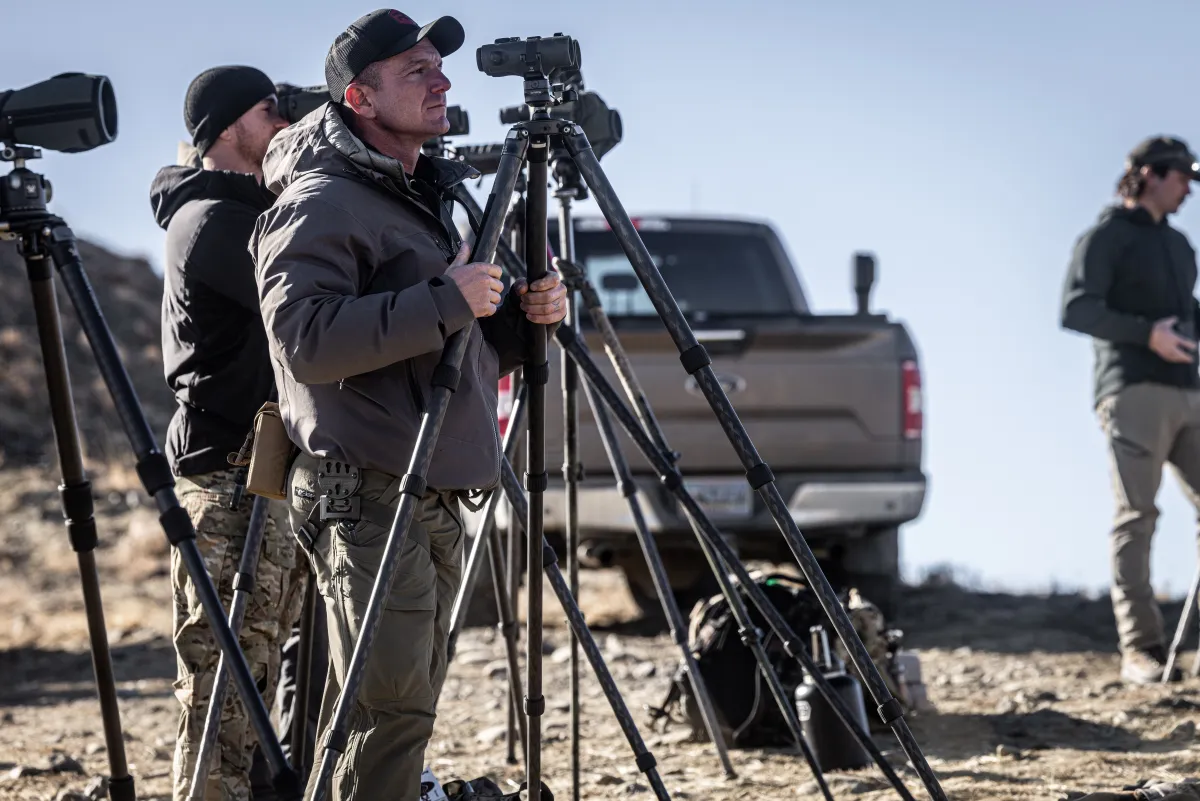
“Don't be afraid to miss. That's the whole point. We learn more from our misses than we do our impacts.”
What you'll walk away with
A position for the problem. A process for the shot.
The goal is not a collection of tripod tricks. It is a shooter who can diagnose the movement, build against the terrain, make the wind call, and own the result.
- Diagnose zero, trajectory, scope, ammunition, and shooter-data problems before they compound
- Identify the source of a wobble zone and choose a correction that actually fits it
- Build a stable tripod with HOLDS on unfamiliar terrain without guessing
- Shoot standing, high kneeling, low kneeling, and seated benchmark positions
- Read a prop and create an adaptive position from its balance point
- Use tripod rear, bag rear, and hybrid support to control recoil and spot impacts
- Apply TREAD, Gun Number, and TRACE to make faster and more honest wind calls
- Validate Level 2 ballistic effects and know when a solver solution does not make sense
- Complete scored known- and unknown-distance engagements from multiple required positions
On the range
The framework stays the same.
From the first tripod build to the last scored run: observe honestly, make a deliberate decision, and let the impact teach you.
Prerequisite & preparation
Show up ready to progress.
Complete Foundation first, or arrive with equivalent experience:
- Safe rifle handling
- A repeatable prone position
- A confirmed zero
- Validated ballistic data
- The ability to build and deliver your own basic firing solution
You will receive the complete rifle, tripod, ammunition, support-gear, and sustainment list after registration.
See the gear our instructors runLevel 2 syllabus See the full syllabus 6 modules
The rifle, the position, the wind, and the target are treated as one connected system. Every classroom framework is followed by live repetitions and a scored application.
Wobble zone & benchmark positions
- Acceptable wobble for the target and distance
- Lateral, horizontal, mechanical & wind-induced wobble
- Standing, high kneeling, low kneeling & seated
- Slow-fire refinement plus timed build-and-break reps
Tripod setup: HOLDS
- Height for eye relief and spine alignment
- Orientation and leg length for terrain and position
- Head drag that supports without fighting the rifle
- Stance, tripod loading, clamps & attachment methods
Adaptive positions & rear support
- Balance-point technique on unfamiliar props
- Low standing, mid-height kneeling & modified prone
- Tripod rear, bag rear & hybrid support systems
- Recoil management and spotting your own impacts
Wind process: Level 2
- TREAD: Time, Read, Estimate, Arrive, Deliver
- Wind rose angles, true wind value & gradients
- Mirage as a speed and direction indicator
- Gun Number mental math and the TRACE drill
External ballistics: Level 2
- Truing and trajectory-validation methodology
- Direction of fire and DSF
- Spin drift, Coriolis & aerodynamic jump
- Inputs that move impact, and those that do not
Scored field application
- Five-target Cadre Engagement and Scoring System
- Known and unknown distance with no wind assistance
- Mandated and shooter-selected multi-position courses
- Introductory PRS and NRL Hunter stage formats
Train with us
Ready to find out what holds up?
Advanced runs at select host ranges throughout the year. Find a date and venue that work for you, then bring the process you built in Foundation into three days of positions, wind, and measured standards.