
Ballistics
External ballistics 101
What actually happens to your bullet in flight.
Most shooters meet external ballistics as a number. You type your bullet, your velocity, and the weather into an app, it hands you a come-up, you dial it, and the round hits. That works right up until it doesn’t: a cold morning, thin mountain air, a switchy crosswind at a mile. Then you want to know why the number is the number. That's what this is for.
- Pillar
- External ballistics
- Level
- Intermediate
- Format
- Classroom primer
- Math required
- None
How we'll do this
The long phase of the bullet's life.
This is the written version of the way we teach external ballistics in the classroom. It's the long phase of the bullet's life: from the instant it leaves the muzzle to the instant it hits the target, with nothing touching it but physics. We're going to walk that flight in order — what external ballistics is, what a trajectory is actually made of, how drag and the atmosphere bend it, and then the part most articles skip entirely: what the bullet is physically doing in those first few yards, where it's wobbling, yawing, and fighting to settle down.
A word on how we'll do it. External ballistics gets dense fast. There are equations underneath all of this that fill textbooks. We're not going there. We're going to use plain language and analogies to get you to true enough, a working understanding you can actually shoot with, and one that clears up the myths and shooting-bench dogma that get repeated until they sound like fact. No physics background required. Every section ends with the one thing to walk away with.
§ I The flight from the outside
The path, the air, and the math.
Six parts on what the bullet's flight looks like from the outside — before we climb inside the bullet itself.
What external ballistics is
Ballistics splits into three phases, and it helps to know which one you're standing in.
- Internal — everything inside the gun. Powder burning, pressure spiking, the bullet accelerating down the bore. Ends the instant the bullet clears the muzzle.
- External — the free flight. The bullet on its own, gravity and air working on it, all the way to the target. This is the whole subject here.
- Terminal — what the bullet does when it arrives: expansion, penetration, energy transfer.
External ballistics is simply the study of the projectile's behavior in that middle phase — how gravity, drag, and the atmosphere steer it after the muzzle and before the target. It's the bridge between two things you can control: the conditions at the muzzle (your velocity, your bullet) and the impact downrange. It's the phase your solver predicts, and the source of every come-up you dial, which is exactly why it’s worth learning.
External ballistics is the bullet's free flight, muzzle to target. It’s the phase your solver predicts, and every come-up comes out of it. That’s the reason to study it.
The trajectory and its parts
A trajectory is the curved path the bullet flies from muzzle to target. It's never a straight line and never a simple arc you can eyeball. You need the vocabulary, because every number on your turret is one of these parts.
- Muzzle velocity — how fast the bullet starts. After the bullet itself, the single biggest input to everything downstream.
- Line of sight — the straight line from your eye through the scope to the target.
- Line of departure — the direction the barrel is actually pointed. It is not the same as your line of sight.
- Sight height — how far the center of your scope sits above the center of the bore. An inch and a half to two inches on most rifles — and it matters more up close than people expect.
- Zero range — the distance where the bullet's path crosses your line of sight for the zero you chose.
- Max ordinate — the highest point the bullet reaches above your line of sight on the way to the target.
- Time of flight — how long the bullet is in the air. The clock that wind and gravity run on.
- Drop — how far gravity pulls the bullet below the bore line over that time.
- Wind drift — how far the air pushes it sideways over that same time.
Here's the piece that trips up new shooters. Because your scope sits above the bore, the barrel has to be angled slightly up relative to your line of sight for the bullet to ever reach the crosshair. You aren't aiming the barrel at the target — you're aiming it slightly above, so the bullet arcs up, crosses your line of sight, peaks at the max ordinate, and falls back down to cross your line of sight again at your zero. The bullet is falling the entire flight.
That's what a firing solution is: an accounting of that arc, so your point of aim and point of impact line up at the distance you want. And here's the rule that governs the rest of this article — as range increases, gravity and drag get more time to work, so drop grows and wind sensitivity grows faster than the distance does. Doubling the range much more than doubles the problem.
The barrel points slightly up; the bullet always falls. The firing solution is just the math that lines up aim and impact — and every error gets worse with distance, not in proportion to it.
Ballistic coefficient: how well the bullet fights the air
The air is the medium the whole flight happens in, and drag — air resistance — is what bleeds off the bullet's speed. The number that describes how well a given bullet fights that drag is its ballistic coefficient (BC).
A high-BC bullet is slippery: it holds its velocity, so it drops less, drifts less, and arrives faster. A low-BC bullet sheds speed quickly and gets pushed around more. So far, so simple.
Here's the part almost everyone gets wrong: BC is not a magic stand-alone number. It's a comparison. Your bullet's BC describes how its drag stacks up against a standard reference projectile tied to a specific drag model. Change the reference shape and the same physical bullet gets a different BC. That's why a BC only means something when you know which drag model it's tied to — the source of the famous G1-vs-G7 confusion we'll unpack shortly.
BC measures how well a bullet fights drag — but only relative to a standard shape. It's a comparison, not a magic constant, which is why the drag model behind it matters.
The atmosphere: drag is never constant
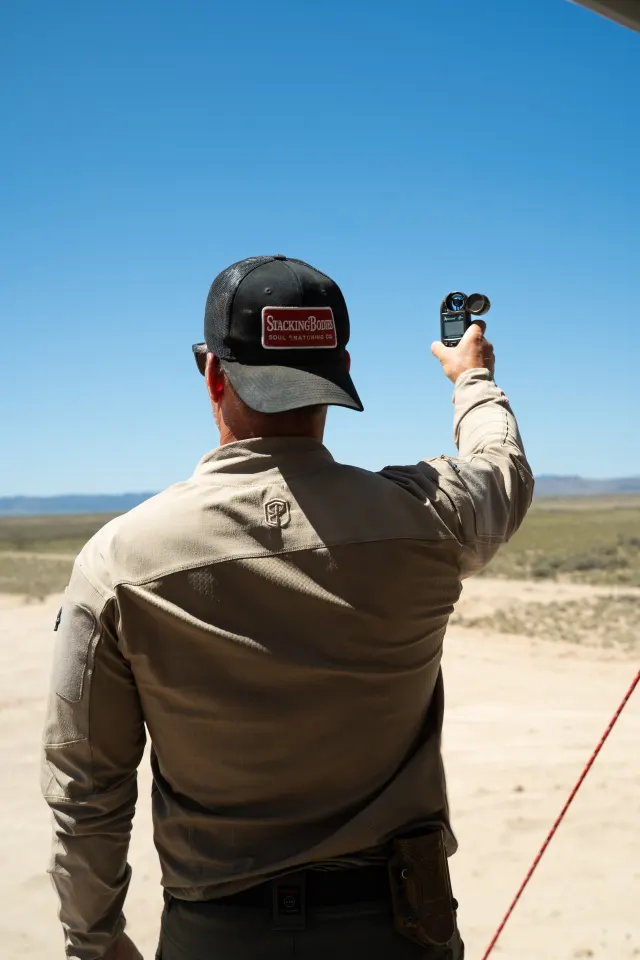
If drag stayed the same all day, ballistics would be a one-time calculation. It doesn't. The bullet is swimming through air, and how thick that air is — its density — changes constantly. Denser air means more drag, more drop, and more drift. Thinner air means less of all three. Three things move that density, and they don't carry equal weight. Wind is the fourth input, and it doesn't change the air at all.
- Temperature
Warm air is less dense, so it produces less drag. Cold air is denser and increases drag. But temperature is sneaky — it hits you twice. Besides thinning or thickening the air, it changes your muzzle velocity, because powder burns differently hot or cold. Your solver handles the air-density side from the temperature you enter. Current solvers can handle the velocity side too, through a powder temperature-sensitivity table, but only after you fill it in with chrono data shot at two different temperatures. Until you do, that part is on you, which is why temperature-stable powders and re-checking velocity in real cold or heat matter.
- Pressure and density altitude
Higher pressure means denser air and more drag; lower pressure (or higher elevation) means thinner air and the bullet holds velocity better. This is the biggest atmospheric lever — and the one people botch most. The pressure that matters is station pressure (the actual pressure where you're standing). The barometric pressure your weather app reports is corrected back to a sea-level equivalent, so it reads near 29.92 almost everywhere. Some solvers want station pressure entered directly. Others take barometric pressure plus your altitude and do the conversion themselves. Know which one your app is asking for.
Feed the weather-app number into a station-pressure field at elevation and you'll tell the solver the air is far thicker than it is — enough to miss at 1,000 yards. A weather meter reads station pressure directly and rolls everything into one tidy number called density altitude: high DA means thin air and less drop, low DA means thick air and more drop. Track that one number and you've captured most of the atmosphere.
- Humidity
The counterintuitive one. Humid air is less dense, not more — water vapor is lighter than the air it displaces — so muggy air actually produces slightly less drop, the opposite of how "thick soupy air" feels. And the effect is tiny: roughly 1% from bone-dry to saturated. At normal ranges you can practically ignore it.
- Wind
Wind is its own animal, and it's the big one. It pushes the bullet sideways (horizontal drift) and — through aerodynamic jump, which we'll get to — it can even nudge the bullet vertically. Wind reading stays the single largest practical error source in long-range shooting, because unlike the others it can't be measured once and dialed. It has to be read, live, every shot.
Drag changes because air density changes. Pressure is the master lever, so give your solver the pressure it asks for: station pressure, or barometric plus altitude. Temperature is second and also moves your velocity; humidity is nearly nothing; wind is a whole skill of its own.
The evolution of drag models: G1, G7, and radar
Now back to that "standard reference projectile." This is where the G1-vs-G7 question finally makes sense.
Back in the 1880s nobody could solve a bullet's drag from scratch by hand — drag changes with speed in a messy, non-linear way. So they did the practical thing: they fired one standard projectile over and over, measured exactly how its drag behaved at every velocity, and wrote it down in tables. From then on you didn't measure your bullet's drag from nothing — you measured how yours compared to the standard, got one number, and the tables did the rest. That number is the BC, and the standard it's measured against is the drag model.
- G1 — the original standard: a short, flat-based projectile shaped like a 19th-century artillery shell. It became the default for one reason — it was first, and the tables already existed. To this day most factory ammo prints a G1 BC.
- G7 — a newer standard shaped like what we actually shoot now: long, pointed, boat-tailed. Because the reference looks like a modern match bullet, the BC barely changes as the bullet slows down.
That last point is the whole reason it matters. A modern boat-tail bullet measured against the blunt G1 shape gives a BC that drifts noticeably as the bullet slows — because the shapes don't match. Measured against the G7 shape, the same bullet's BC stays much more consistent. So the rule isn't "G7 is always better." It's: match the model to the bullet's shape. Long sleek bullet → G7. Short flat-based bullet (a stubby varmint or pistol slug) → the old G1 shape is actually closer. One hard rule: never compare a G1 number to a G7 number — they live on different scales for the exact same bullet.
Then comes the modern chapter. Instead of comparing your bullet to any standard shape, what if you just measured your actual bullet's drag directly? That's what Doppler radar does. Hornady and Applied Ballistics fly bullets in front of radar and record real drag at hundreds of points along the flight, then build a custom drag curve for that specific bullet. Across changing velocity bands — especially down low near the speed of sound, where each bullet's drag gets weird and individual — a measured curve can beat any single published BC.
Inside the normal supersonic window, a good G7 number and a full custom curve land almost on top of each other. The measured-drag advantage really opens up as the bullet slows toward the speed of sound, and that distance depends on the cartridge. At sea level a .308 with a 175 gets there around 1,000 yards; a 6.5 Creedmoor with a 140 holds on to roughly 1,400. The tech is real; the payoff just concentrates at the far end.
BC is measured against a reference shape. G1 = old and blunt (still on most boxes); G7 = modern and sleek (fits today's bullets). Match the model to your bullet, never mix the numbers, and know that radar-measured custom curves are the most precise step — mostly mattering at extreme range.
How the solver thinks: point mass vs. 4DOF
When your app turns all that into a come-up, it's running one of two kinds of engines, and it's worth knowing which.
- Point mass solver — treats the bullet as a single point moving through space and uses drag inputs to predict the path. Fast, efficient, and — fed a well-matched drag model and honest inputs — plenty accurate for the vast majority of practical shooting. Applied Ballistics runs a point mass engine on measured custom drag curves.
- 4DOF solver — Hornady's engine, named for four degrees of freedom. It adds the bullet's spin to the point mass math and uses the bullet's length and shape, so it can calculate spin drift and aerodynamic jump for that specific bullet. Paired with Hornady's measured, bullet-specific drag data, it can squeeze out more fidelity.
The honest comparison: a point mass solver with a good drag curve is enough for most people, most of the time. The advanced engines earn their keep as range stretches out, conditions get weird, or you simply need every last bit of precision. Either way, the engine matters less than the discipline of feeding it the truth — your real muzzle velocity from a chronograph, and station pressure from a meter.
And no matter how good the solver, you still true it: shoot known distances, compare real impacts to the prediction, and nudge one calibration knob until the math agrees with the steel. The app is a hypothesis; your rifle is the truth.
Once the core profile is honest, the solver can also account for smaller effects that start to matter as range stretches or targets shrink.
- Spin drift — a spin-stabilized bullet drifts with its twist direction over time. Enter twist rate and direction correctly; do not add a manual hold if the solver already includes it.
- Coriolis — Earth's rotation acts on every shot, but the solver can only correct for it when it knows your latitude and firing azimuth. Stale compass data can make the correction worse than leaving it off.
- Angle shooting — uphill and downhill shots need less elevation than line-of-sight range suggests because gravity acts over the horizontal distance. Use the rangefinder/solver angle solution instead of guessing.
Point mass is enough for most shooting; 4DOF and custom curves add fidelity at distance. But every solver is only as good as your inputs, and none of them are trusted until you've trued them against your own impacts.
§ II Inside the bullet
What the bullet is doing in the first few yards.
Everything up to here is the flight from the outside. Now we go inside the bullet itself — into the part most primers skip: what it's physically doing in those first critical yards, where it's wobbling, yawing, and fighting to settle down.
Muzzle exit: the most violent moment of the flight
If there's one thing to take from the back half of this article, it's this: the muzzle is where the bullet is most vulnerable, and the most can go wrong. Everything downrange is partly decided in the first few inches.
Think about what's actually happening at the crown. The bullet has been sealed in the bore, riding a column of burning gas at enormous pressure. The instant it uncorks, that hot, high-pressure gas — moving faster than the bullet itself — comes blasting out around it. If that gas escapes evenly, all the way around, the bullet exits clean. If it escapes unevenly, it kicks the bullet, inducing yaw (the nose tipping off the line of flight) before the bullet is even fully clear.
Three things drive whether that gas release is symmetric:
- The crown — a nick, a burr, or an uneven cut at the muzzle's edge lets gas dump out one side first. That asymmetric push tips the bullet. This is why a damaged crown wrecks accuracy out of proportion to how small the damage looks.
- Muzzle devices — an asymmetric brake or a poorly timed device can disturb the gas flow on its way out and disrupt the bullet as it transitions from bore to free air.
- Barrel length — shorter barrels uncork at higher pressure, so the blast at the muzzle is harsher. A short barrel with a clean crown still groups; the real cost is velocity.
The muzzle is the most chaotic moment of the flight. Symmetric gas release — a clean crown and a square device — lets the bullet leave straight. Asymmetric release tips it before it's even free.
The first few yards: six degrees of freedom and the spinning top
The instant the bullet clears the muzzle, it goes from being trapped in the bore to being free to move in six different ways at once — what engineers call six degrees of freedom. Three are straight-line motions and three are rotations:
- Three translations — up/down, left/right, and forward/back.
- Three rotations — roll (spin around its own long axis — the good one, the spin your rifling put on it), pitch (nose tipping up and down), and yaw (nose swinging left and right).
The roll is the spin that stabilizes the bullet, on purpose. The pair we worry about is pitch and yaw — the nose wobbling off the flight path. Because a spinning bullet that's just been kicked at the muzzle doesn't fly perfectly nose-forward. It wobbles.
The right picture is a spinning top. When you first spin a top, it doesn't stand straight up — it leans and traces lazy circles, the tip wandering around, before it settles and stands tall. A bullet does the exact same thing, and the motions even share the names physicists give a top: precession (the nose sweeping in a slow circle) and nutation (a smaller, faster nod riding on top of that circle).
What happens next is the whole ballgame. If the bullet is well-designed and stable, those oscillations dampen out over the first few hundred yards — the wobble shrinks, the nose settles, and the bullet flies clean point-forward. Shooters call this "going to sleep." A bullet that's gone to sleep is doing exactly what you want. A bullet that never settles — or whose wobble grows — is throwing accuracy away the whole flight.
A bullet leaves the muzzle wobbling like a just-spun top — precessing and nutating. A good bullet's wobble dampens out and it "goes to sleep." That settling is what stability is really about.
Gyroscopic stability: the pry bar
So what decides whether a bullet settles down or shakes itself apart? Most shooters will tell you it's twist rate and bullet length — spin a long bullet fast enough and you're done. That's the popular shorthand, and it's not wrong so much as it's incomplete. Stability comes from the relationship between two points inside the bullet:
- Center of gravity (CG) — the bullet's balance point, fixed by how its mass is distributed. It doesn't move in flight.
- Center of pressure (CP) — the point where the air's push effectively acts. Unlike the CG, the CP moves — depending on the bullet's shape and its speed compared to the speed of sound (its Mach number).
Picture the distance between those two points as a lever arm — a pry bar. The air pushing on the CP, acting through that arm, is what tries to tip the bullet over. The bullet's spin is what resists the tipping. Gyroscopic stability is the spin winning that fight.
Now the counterintuitive payoff, and the reason the muzzle is so unforgiving. At the muzzle the bullet is at its highest velocity, the gas release has just disturbed it, and any pitch or yaw is largest. High velocity also means the aerodynamic forces trying to tip it are strongest. This is where the bullet is least settled and most sensitive to launch problems.
As the bullet slows downrange, those launch oscillations can damp out and the wobble shrinks. That's the mechanism under "going to sleep." Good stability means the bullet gets more settled while velocity remains in a range it can handle; it does not mean a marginally stabilized bullet magically gets better forever.
Stability isn't just twist and length — it's spin overpowering the air's tip-over force, acting through the gap between the bullet's balance point and its pressure point. The muzzle is where the bullet is least settled; good stability lets that wobble damp as it flies.
The bullet isn't perfect: manufacturing and your 100-yard group
Here's a humbling idea: a chunk of the spread in your groups isn't you. It's the bullet — specifically, tiny imperfections from how it was made, amplified by spin.
- Jacket concentricity and CG offset — if a bullet's jacket is even slightly thicker on one side, the core shifts and the center of gravity ends up a hair off the spin axis. Now you've got an unbalanced tire. Just like a wheel with a bad weight, the faster it spins, the worse it wobbles — and your bullet is spinning at a couple hundred thousand RPM.
- Crooked engraving — if the bullet enters the rifling slightly tilted, it can exit the muzzle tilted too, launching with a built-in yaw that adds to the dispersion.
Add it up, and at 100 yards a real share of your group size comes from things that have nothing to do with your trigger press — CG offset, yaw induced at muzzle exit, asymmetric gas escape, and engraving tilt. These combine into a random circular spread around your point of aim — a scatter baked into the ammo and the launch, not your fundamentals.
It's worth knowing for two reasons. One: it's why even a perfect shooter with a perfect rifle still shoots a group, not a single hole. Two: it's why bullet quality, consistent seating, and a good crown actually show up on paper — they're shrinking that built-in circle.
Part of every group is the bullet, not the shooter — uneven jackets and crooked engraving spin up into wobble and yaw. It lands as a random circle around your aim. Good bullets and a clean launch shrink that circle.
Aerodynamic jump: why a crosswind moves your bullet up
This is the one that makes people's heads tilt, and it's pure gyroscope. A crosswind doesn't just push your bullet sideways — it can move it vertically, and not for the reason you'd guess.
The key fact about any spinning object: when you push on it, it doesn't respond where you pushed. It responds 90 degrees later, in the direction of spin. Push the side of a spinning top and it doesn't fall the way you pushed — it pivots a quarter-turn around. A spinning bullet does the same thing. So for a standard right-hand-twist barrel:
- Wind from the right pushes the bullet toward 9 o'clock. The gyroscopic response shows up 90° later in the direction of spin, at 12 o'clock, so the bullet impacts high.
- Wind from the left pushes toward 3 o'clock, the response shows up at 6 o'clock, and the bullet impacts low.
(Flip both if you're shooting a left-hand-twist barrel.) This is aerodynamic jump — solvers often call it crosswind jump. It's set up right at the start of the flight. The bullet is most sensitive to it at the muzzle, where gyroscopic stability is lowest and the nose is still wobbling. The jump is essentially decided in the first instant and carried all the way to the target.
One caution against memorizing a rule of thumb: aerodynamic jump is bullet-specific. How much a given crosswind jumps a given bullet depends on its shape, its mass distribution, its twist rate, and its stability factor. There's no single universal number — which is exactly why a good 4DOF or custom-curve solver, which models this from the bullet's real properties, beats a back-of-the-napkin guess.
A spinning bullet responds to a push 90° around, in the spin direction — so on a right-twist barrel a right wind sends it high and a left wind sends it low. It's set at the muzzle, it's real, and it's bullet-specific.
Dynamic stability and late-flight wind
Two last pieces to close the flight.
Dynamic stability is a separate thing from gyroscopic stability. Gyroscopic stability asks whether the bullet has enough spin to resist tipping. Dynamic stability asks a different question: once the bullet is wobbling, do those yaw oscillations shrink or grow over a long flight? A dynamically stable bullet's wobble damps down (it goes to sleep and stays asleep). A dynamically unstable one can have plenty of spin yet still let its wobble build up over distance. The good news: poor dynamic stability is rare in quality commercial bullets, because manufacturers engineer it out. It's mostly a concern at the fringes — wildcat projectiles, odd twist pairings, transonic flight way out there.
Wind over the whole flight. We covered drift and aerodynamic jump, but there's a subtler interaction worth naming. A crosswind doesn't just shove the bullet — it increases the amplitude of the nose's oscillation, stirring the wobble back up. And wind early in the flight costs you the most, because a push in the first couple hundred yards changes the direction the bullet is flying, and that error keeps opening all the way to the target. Combine that with the fact that drift grows faster than distance (double the wind and you double the drift, but double the range and you more than double it), and you get the practical truth every long-range shooter learns: wind near the muzzle and wind the bullet flies through for a long time both punish you more than the simple "it's a 10 mph crosswind" math suggests.
Gyroscopic stability is "enough spin to not tip"; dynamic stability is "does the wobble shrink or grow over distance" — and good factory bullets have the latter handled. Wind early in the flight costs the most, and drift grows faster than distance.
If you remember nothing else
The walk-away list.
- External ballistics is the free flight, muzzle to target — the phase your solver predicts, which is why it's worth learning.
- Learn the trajectory's parts. The barrel points slightly up, the bullet always falls, and every error grows faster than distance.
- BC is a comparison, not a magic number — it only means something against a drag model.
- Drag is never constant because air density isn't. Give your solver the pressure it asks for: station pressure, or barometric plus altitude. Pressure first, temperature second, humidity almost nothing.
- G1 = old and blunt, G7 = modern and sleek. Match the model to your bullet, never mix the two numbers, and know radar-measured custom curves are the most precise step — mostly at extreme range.
- Point mass is enough for most shooting; 4DOF adds fidelity at distance — but only honest inputs and truing make any solver trustworthy.
- The muzzle is the most violent, most decisive moment. A clean crown and a square device let the bullet leave straight.
- A bullet leaves wobbling like a spun top and either "goes to sleep" or doesn't. Launch is where wobble is largest; good stability lets that wobble damp as the bullet flies.
- Part of your group is the bullet, not you — uneven jackets and crooked engraving spin up into a built-in circle of dispersion.
- Aerodynamic jump is real: on a right-twist barrel, a right wind sends the bullet high, a left wind low — set at the muzzle, bullet-specific.
Closing
The number is the answer to a question you can picture.
The bullet that lands on your target is the end of a story that mostly got written in the first few yards — kicked by gas, wobbling like a top, fighting to go to sleep, carrying whatever imperfections it left the factory with. The shooter who understands that flight stops treating the number on the turret as magic and starts treating it as the answer to a question they can actually picture.
That's what we do in our external ballistics class. It's classroom, non-live-fire, no math background required — a couple of hours spent on the why behind every number you dial, taught with the analogies and plain language you just read. Come learn what really happens after the trigger breaks.
Train with us
Learn the why behind every number you dial.
Reading the primer gets you started. Two hours in the classroom — plain language, no math, every analogy you just read drawn out and answered — is how it sticks.