
Rifle system
The team pack dump
What two Scout Snipers actually carry into a match.

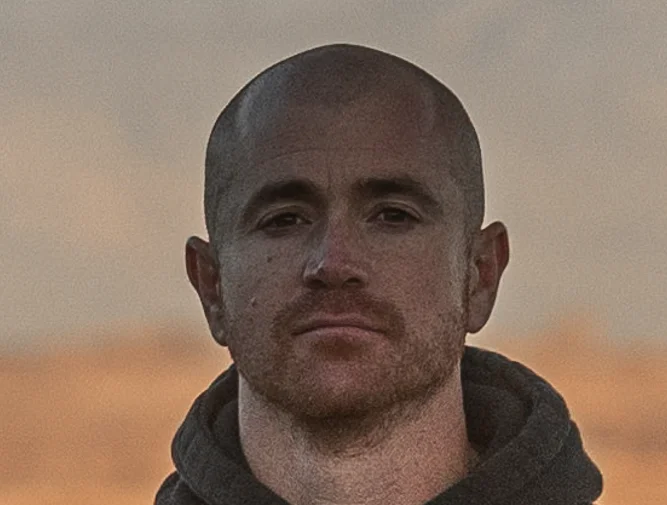
About seven stages into the 2026 NRL Hunter match at Mason Valley, California, with the thermometer around 85 degrees, Phil and Jon laid out everything they were carrying. Rifle to rangefinder to the rain jacket that never comes out. Two Marine Scout Snipers shooting as a team, on rifles that overlap more than you'd expect. Here's the whole loadout, piece by piece. The part that matters most if you're headed to your first match: how little of it you actually need.
- Format
- NRL Hunter
- The rifles
- 2× 6.5 Creedmoor
- The packs
- Stone Glacier Approach 2800
- The point
- None of it's required
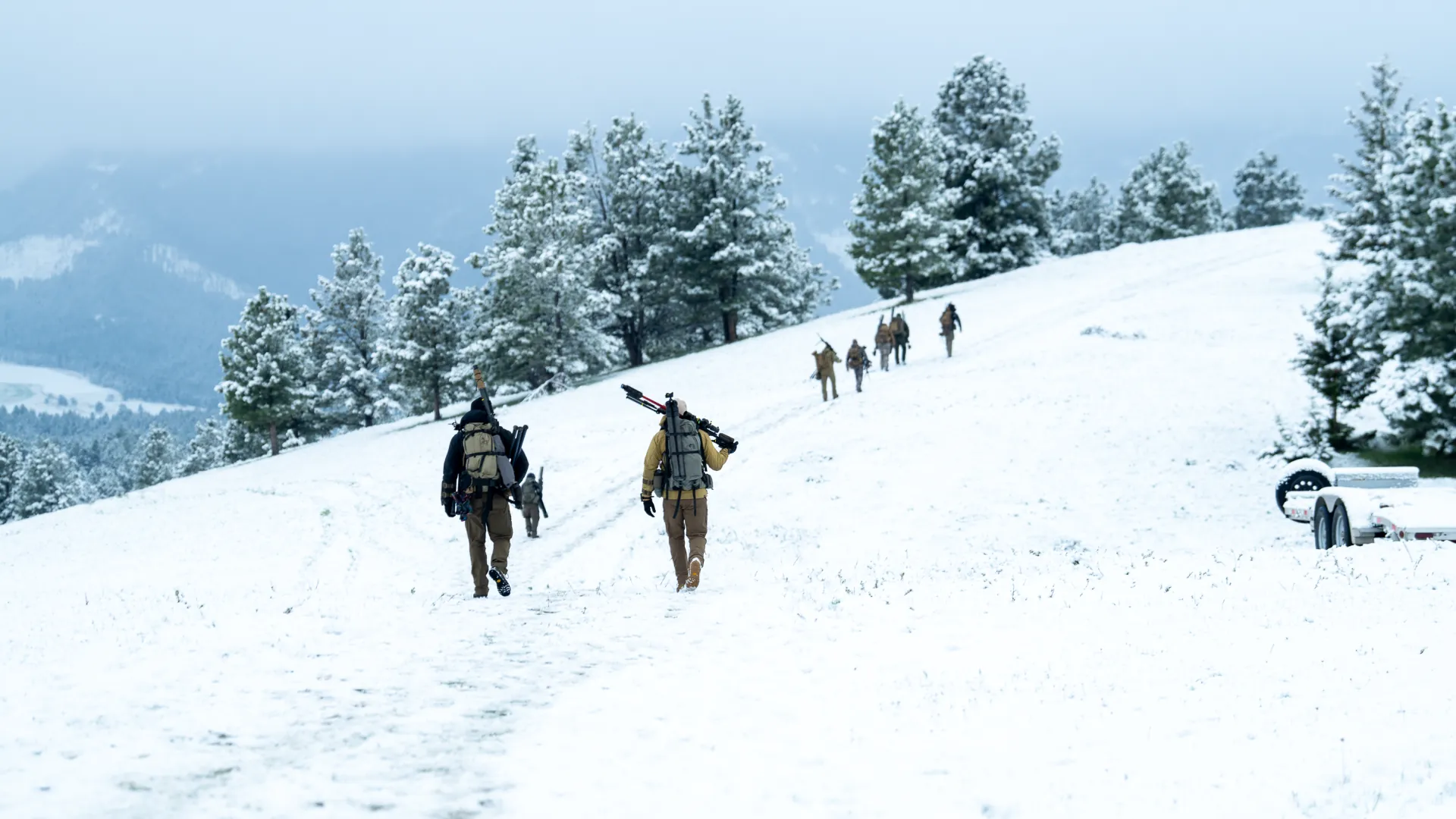
Why a pack dump
Two shooters, one kit list
Watch enough match videos and the gear starts to look like the price of admission. Racks of glass, carbon everything, a bag for every position. It isn't. In Phil's words, this kit is there "to be at the most pinnacle of our competitive advantage as we can be." He's also the first to say none of it is required.
The first thing you'll notice is how much Phil's and Jon's rifles overlap. Same chassis, same barrel, same trigger, same can, same glass. Some of that overlap is borrowed. Able loaned them both Theorem L cans for this match, and the KAHLES K525i on Jon's rifle is one of Phil's optics.
Act 1 · On the rifle
The build sheet
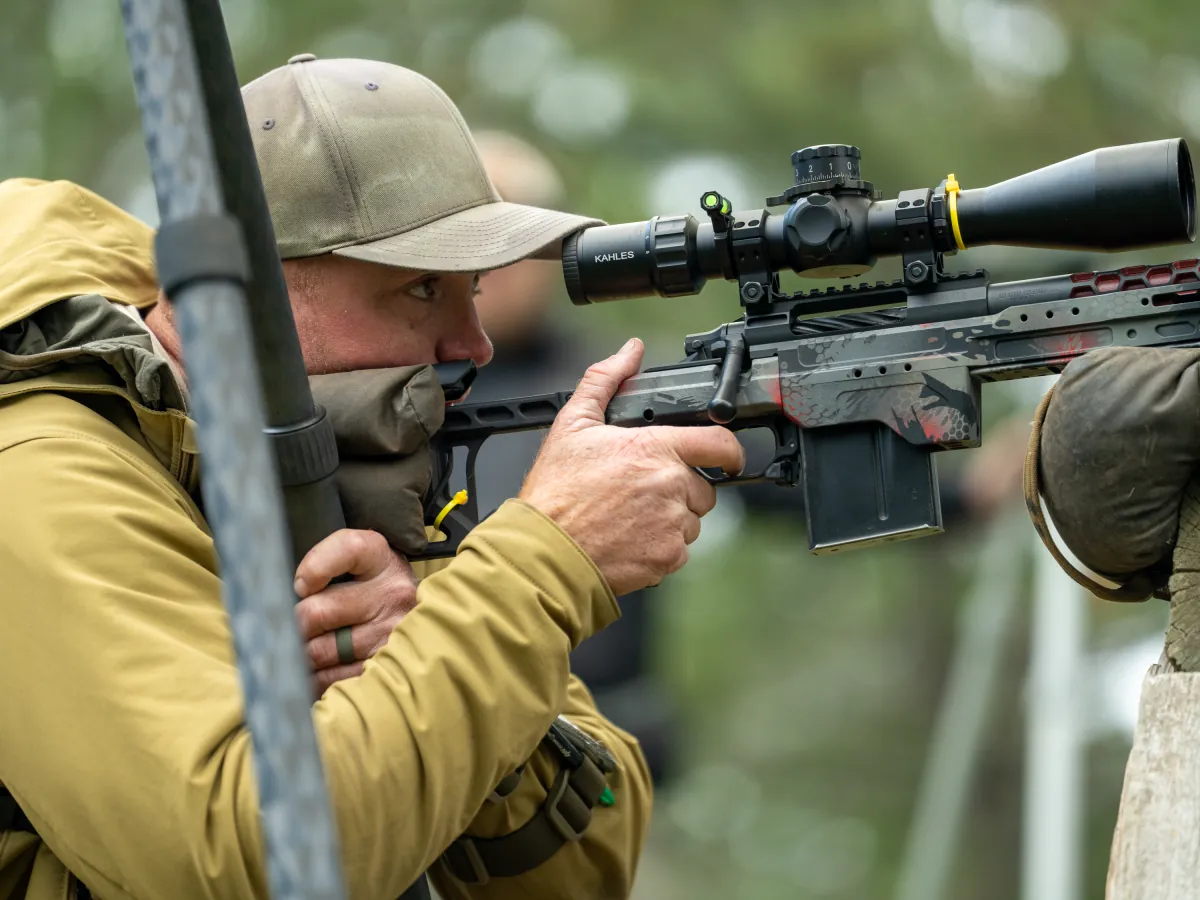
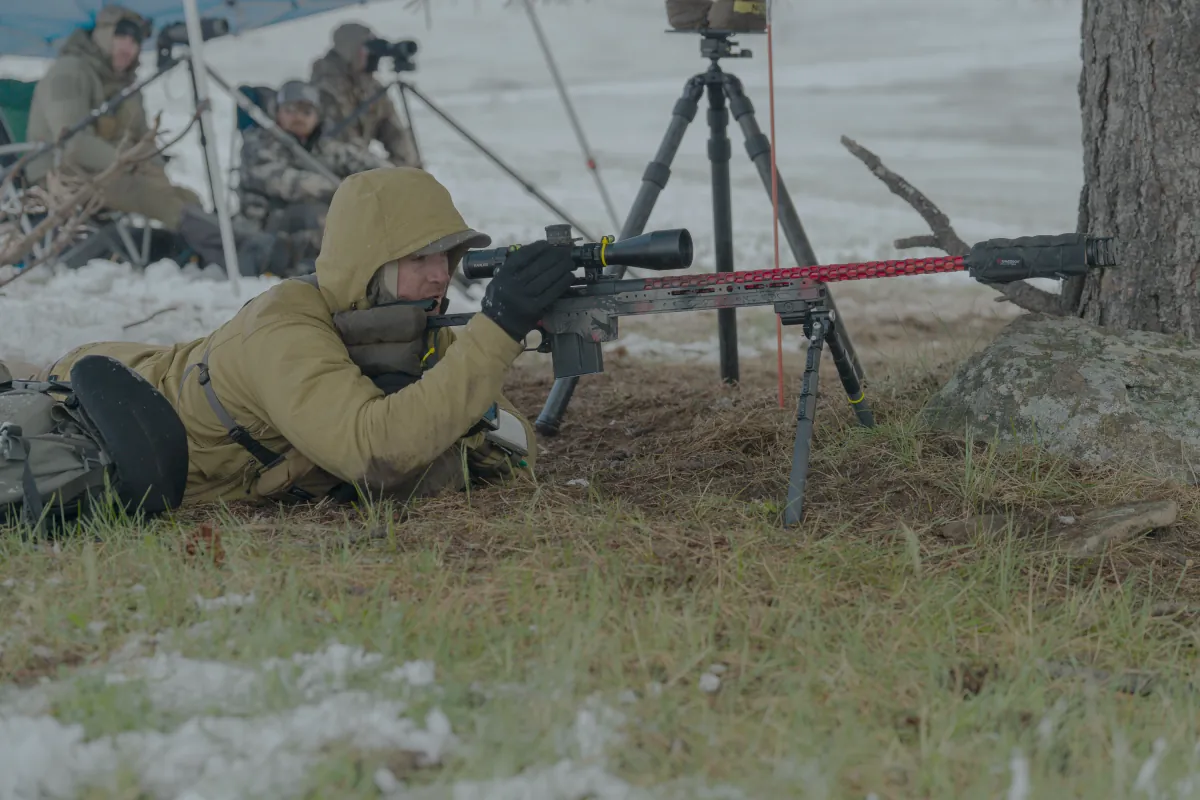
Both rifles are 6.5 Creedmoor in a KRG Whiskey-3 Pro, wearing a Proof carbon barrel, a TriggerTech Diamond, an Able Theorem L can, and a KAHLES K525i. The differences come down to the action and the mount. The cans are on loan from Able, and Jon's K525i belongs to Phil.
| Part | Phil | Jon |
|---|---|---|
| Caliber | 6.5 Creedmoor | 6.5 Creedmoor |
| Action | Defiance Deviant (Short Action Customs build) | Zermatt Arms TL3 |
| Barrel | Proof carbon 24" 1:8 | Proof carbon 24" 1:8 |
| Chassis | KRG Whiskey-3 Pro | KRG Whiskey-3 Pro |
| Trigger | TriggerTech Diamond 2-stage | TriggerTech Diamond 2-stage |
| Suppressor | Able Theorem L with brake (on loan) | Able Theorem L (on loan) |
| Optic | KAHLES K525i (SKMR+) | KAHLES K525i (Phil's) |
| Level | Flatline Ops Halo X | Flatline Ops Halo X |
| Mount | Badger Ordnance C1 Max | Spuhr |
| Bipod | MDT CKYE-POD (R3D legs) | MDT CKYE-POD (R3D carbon) |
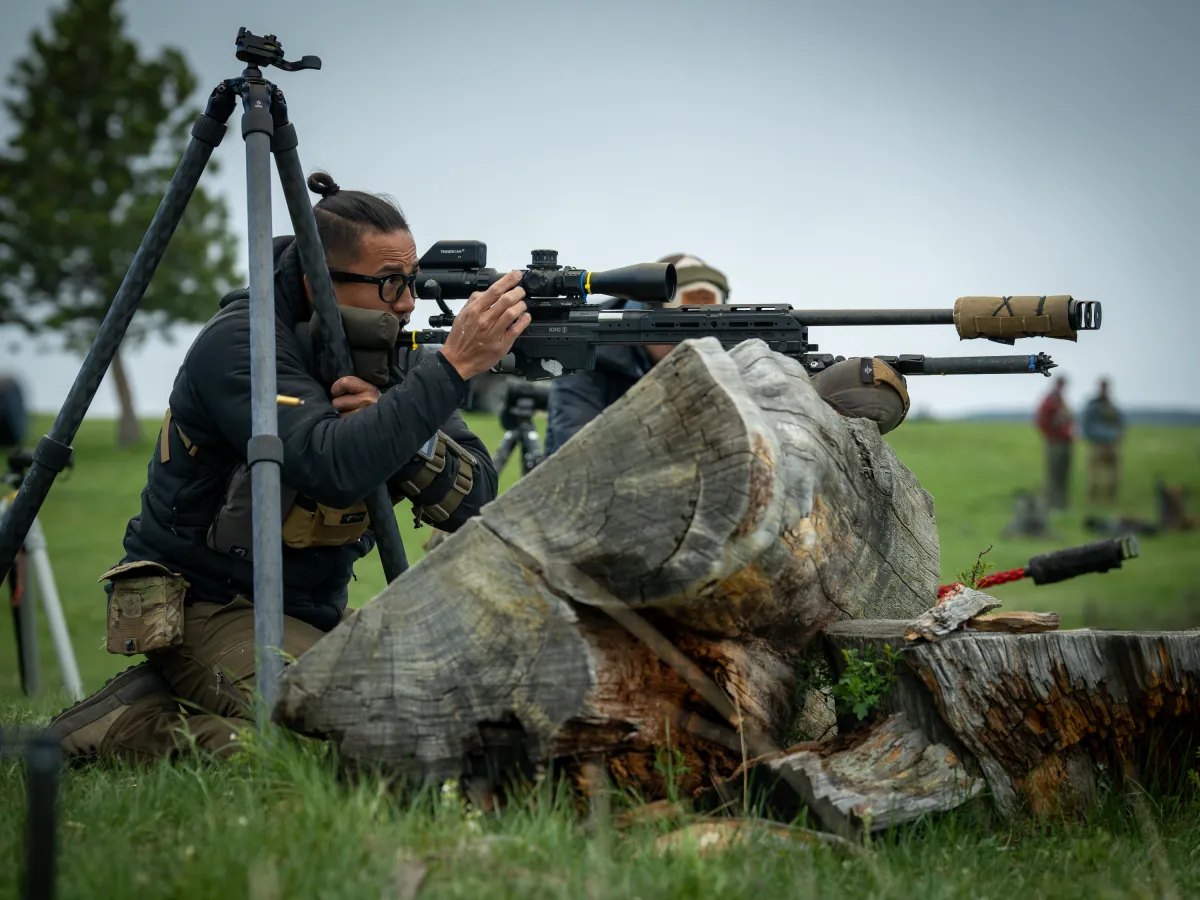
The whole rifle, as Phil runs it, weighs sixteen pounds on the dot, with external weights on the chassis. That's the NRL Hunter limit for Teams and Open Heavy, and it drives a lot of the choices on the sheet. The Proof carbon barrel sheds weight up front so a suppressor and a heavy bipod can stay on and still make weight. Jon's running the four-section R3D carbon legs on his CKYE-POD for the first time: a little more flex than the three-section, but light enough to justify keeping the can and the rear-support setup on the gun. Every part on a hunter rifle is paying rent against the weight you carry up the hill.
Act 2 · On the body
What rides on you
The build sheet is the easy part. The kit that decides whether a stage goes smoothly is the stuff within arm's reach — on the chest, on the belt, never in the pack.
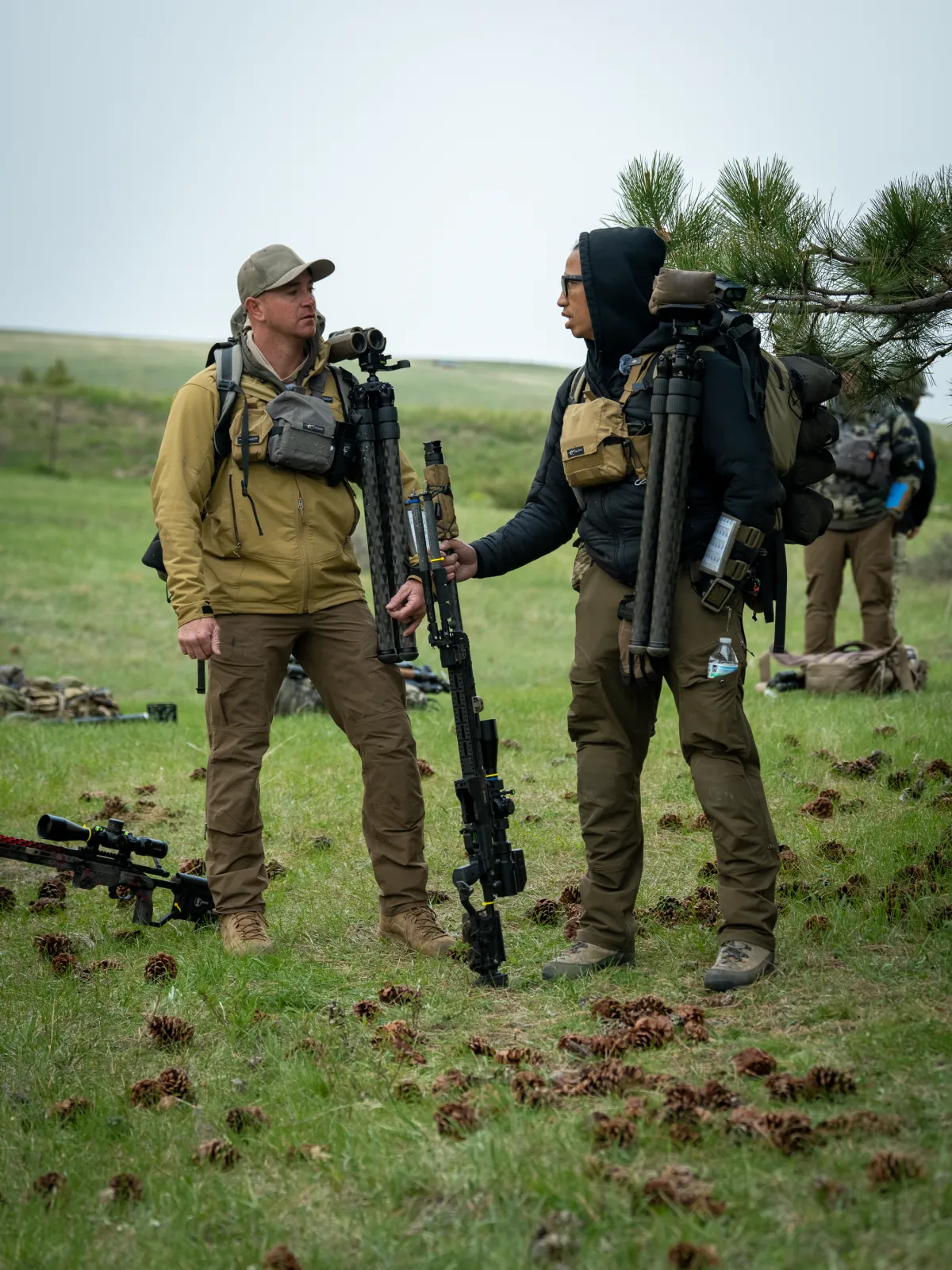
Both run a Stone Glacier Sentinel bino harness on the chest — binos, a Kestrel, note cards, and a primary magazine where a hand can find them without looking. The belt carries spare mags and a backup rangefinder, so glass and a range number are always one reach away even if the pack is off and ten feet behind you.
The rangefinding stacks up in tiers. Phil's primary is a set of Vectronix 10×42s, with a Vectronix Terrapin X on the belt as his backup. Jon carries Sig Kilo binos as backup glass and a little Sig Kilo handheld as his tertiary. That one is "always in there for hunting," and in his words, "really just kind of a filler at this point." It looks like overkill until a unit fogs, dies, or won't range a far edge — then the tiered setup is just redundancy doing its job. Riding alongside it: a Sun & Shadow armboard with Cadre dope cards, plus a Garmin 901.
Act 3 · In the pack
The pack breakdown
It all goes in a Stone Glacier Approach 2800. Here's how the inside breaks down — the support gear that builds a position, and the stuff that earns its place by being filler.
Tripod & support
A Really Right Stuff tripod is the backbone — Phil on a Versa 43i, Jon on a 22i for glassing and observation. Front and rear bags from Armageddon Gear — a Shmedium with heavy fill up front, an OG with Git-Lite in the rear — build a stable position off almost any prop the stage throws at you.
Ammo & glass
Ammo lives in a Cole-TAC pouch (Jon's is the Area 419 collab) that holds 120 rounds — the day's count, in one place. Phil's Swarovski spotter is there for phone-scope footage. Jon's Nightforce CFS, with a rangefinder on top, is his go-to for finding targets, and the match directors hid them well.
The filler
Rain layer, extra batteries, snacks, a notebook, a shooting mat. Half of it never comes out — and that's fine. As Jon puts it, the mat is in there partly so the tripods don't slide around. In an 85° summer pack-out, the rain gear is insurance you carry and hope to waste.
Act 4 · Match-day tips
What you actually need
"There's a lot of skilled shooters that are out here that have the bare minimum, which is just their rifle, their rangefinder, and a positive mental attitude." Phil Velayo, Mason Valley 2026
Here's the part the gear shots leave out. None of this full loadout is a requirement to shoot an NRL Hunter match. "It's a choice," Phil says, and he credits the line to Matt Martini, from a reply in an NRL Hunter community forum. The community carries the rest. Phil has seen experienced shooters help newer ones find targets and give them wind calls. You don't buy your way onto the line. You show up prepared, then learn what actually needs to be upgraded.
So treat this loadout as a map, not a shopping list. Start with a rifle you trust, a way to range, and the willingness to learn in front of people who've done it. Add gear as a specific problem shows up: a position you couldn't build, a target you couldn't find. Let the kit grow into the shooting instead of ahead of it.
The last word
Pack light. Show up. Keep your face on the gun.
A full pack dump looks like a lot because it is. Years of figuring out what survives a match day and what just adds weight. The honest version is shorter than it looks. Bring what lets you range, build a position, and read your data, and leave the rest to grow in over time. Then do the only thing that actually makes a better shooter: get on the gun, miss, learn, and run it again.
Train with us
Bring the rifle you've got
You don't need the full kit to start. You need reps with someone who can call it next to you. Come work the field shot on the range, and let the gear grow into the shooting.