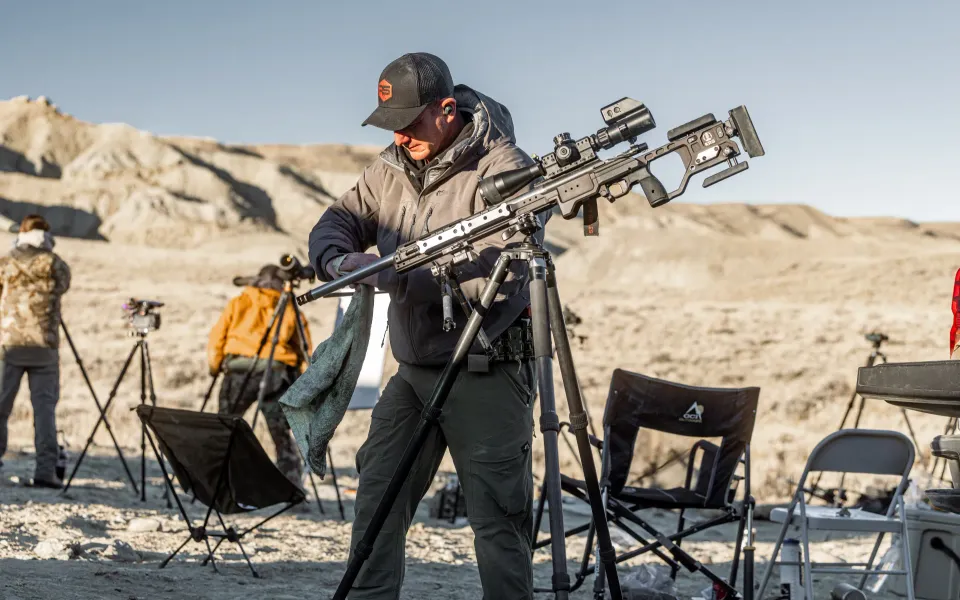
Rifle system
What to bring to your first course
Show up prepared. Leave a better shooter.
So you’ve signed up for your first course with The Cadre. Good — the hard decision is behind you. What’s left is preparation, and it splits into three things: the paperwork you handle before range day, the gear that goes in the truck, and the head you show up with. This page covers all three, in order.
- Level
- First-time student
- Ammo minimum
- 400 rounds, same lot
- Paperwork
- 3 documents before range day
- Read time
- ~12 minutes
Part 1 · Before you arrive
Handle the paperwork first
When you sign up for a class, you’ll get a confirmation email along with three documents. None of it is complicated, but all of it has to be done before you step on the range — and one of them takes outside processing time, so don’t sit on it.
- 01
Background check verification
All students complete a background check through SentryLink before attending. There is a processing fee and results typically come back quickly — but don’t wait until the last minute. Follow the current instructions in your confirmation email, get it done as soon as you register, and it’s off your plate.
- 02
Liability and hold harmless agreement
Read it, sign it, and email it back with the other two forms before day one. Standard stuff, but we need it on file before you step on the range.
- 03
Registration and cancellation policy
Know the terms. If something comes up and you need to reschedule, this spells out exactly how that works — better to know now than to find out under deadline.
Read your confirmation email — all of it
After registration we send detailed logistics: location details, the schedule, and any course-specific requirements. Read it. Print it if you need to. Some of our ranges are remote, and the email is where you find out things like drive time and where to meet on day one.
If the confirmation email gives a different round count, gear requirement, time, or meeting point than this evergreen guide, use the email. It is the class-specific source of truth.
Signed up for a webinar instead of a range course? The documents above don’t apply — just show up online and be ready to learn.
Part 2 · The gear
The packing checklist
Paperwork done — now the truck. Everything below is sorted by how much it matters: the required items first, then the support gear that makes the weekend smoother, then the comfort items people forget. Tick each line as it goes in the bag. Nothing is saved — it’s a live scratchpad for one pass through your kit.
Rifle & optics
RequiredAmmunition
RequiredSupport & data
RequiredPersonal gear
RequiredExtra gear
Bring if you have itComfort & backup
RecommendedA rifle that’s acting up? Fix it before class
If your groups opened up recently or the rifle isn’t shooting the way it used to, work the hardware before range day — loose torque, a backed-off brake, a handguard kissing the barrel. We keep the exact checklist we run at Rifle Troubleshooting. Five minutes with a torque wrench at home beats losing the first morning of class to a mystery.
Part 3 · What to expect
What your course covers
Bag’s packed. Here’s what you’re packing it for. What you’ll cover depends on which course you signed up for. Pick yours below to see what it covers, in order. Signed up for a different course? The class page and your confirmation email have the plan.
This is where most people start, whether you’re new to precision rifle or rebuilding your fundamentals. You leave with a clear picture of where your shooting stands and what to work on next. The number of days depends on the venue, so your class listing and confirmation email have your exact schedule. See the Foundation class page.
System, setup & first rounds
- The precision rifle system: what each part does and why it matters
- Rifle setup and fit: length of pull, eye relief, cheek weld, diopter
- Rough zero: get on paper and build a working 100-yard zero
- Pressure test: an honest baseline before we change anything
- Foundational mechanics: the seven-step shot process
- Zero confirmation and muzzle velocity over the chronograph
Solvers, wind & known distance
- Building your ballistic solver profile: Hornady 4DOF and Kestrel basics
- Truing your data against real impacts
- Wind class: read it, make a call, apply it the same way every time
- Known-distance standards on steel, out past 1,000 yards when the range allows
- Range finding and unknown distance with the R.A.N.G.E. Me process
- Shooter/spotter teams: range, spot, and call corrections together
Standards, the qual & what comes next
- More rounds downrange across known and unknown distance
- The Cadre standards qual: an honest measure of where you stand
- A look at what comes next: positions, tripod work, and the follow-on course
Part 4 · Mindset
The gear that matters most isn’t in the bag
Every item above fits in a truck. The thing that actually decides how much you get out of the weekend is how you show up — and after years of running classes, the pattern is unmistakable.
Show up ready to learn
Even if you’ve been shooting for years, come ready to be a student. Steve Holland went through Scout Sniper Basic School as a Staff NCO, senior to most of the room, with Phil and Jon as his instructors. No bravado about being the senior guy. Phil calls it “a level of humility that was absolutely phenomenal.” On known-distance qualification day Steve spotted for six shooters, and all six passed. Phil named him the class’s High Spotter.
We’re not here to dump our brains on you, either. We’d rather you leave with five things you can repeat on your own than fifty things you’ll forget by next week. (More on our training philosophy.)
“The hardest thing about an instructor is holding back. … They’re only able to retain so much, so less is more.” — Phil, passing on a lesson from his mentor Aaron Davidson
Be honest about where you are
There’s a difference between what your rifle can do and what you can do with it. Steve Holland breaks it down in his rifle troubleshooting walkthrough: “Mechanical accuracy is the limitations of your rifle in its entirety. Practical accuracy is you plus gun equals what.” Your rifle might be capable of half MOA. That doesn’t mean you are — not yet. And that’s the whole point of showing up.
Don’t come trying to prove something. Come trying to learn something. Our instructors aren’t ballisticians or engineers — they’re shooters, same as you. The coaching is straightforward, no BS, and based on what actually works on the range.
The mental game matters
New shooters don’t expect this: when the timer beeps, a lot of what you know goes out the window. Wind calls you were nailing in practice suddenly disappear. Your process falls apart. That’s normal — and that’s exactly why we train it.
One of the biggest things you can do is talk to yourself. Out loud. Will, a PRS shooter who joined Phil and Jon on our competition tips episode, does it at his local matches: “I actually talk to myself out loud on the clock.” When he misses, he says out loud that he needs more wind, and the next shot gets it. Verbalize your wind call before you send the round. Give yourself a standard at each position, the way Will does: “My wobble has to always be inside the plate. If I’m not inside the plate, I’m getting off the prop and I’m figuring out why.” It sounds weird until you try it. The goal isn’t to get rid of pressure. It’s to build a process that holds up under it.
One thing at a time
People always say “slow is smooth, smooth is fast,” and there’s a reason it sticks — that’s how progress actually happens. To be a good shooter you need to be methodical. Work on one thing at a time. Get better at one thing at a time. Take that approach and your processing speed starts getting faster on its own. Don’t rush the process. Trust the process.
It’s the same idea Steve uses when diagnosing rifle problems: if your groups open up, don’t change three things at once. Change one. Test it. Write down what you find. Don’t throw money or guesswork at the problem. Gear, positions, ammo, technique — same approach across the board. That’s why the notebook is on the checklist: what you capture during class is what makes your practice at home actually useful.
Misses are data
You’re going to miss. That’s part of the deal. What matters is figuring out why you missed — was it the position? The wind call? The trigger press? Something mechanical? Every miss tells you something, and we’re here to help you read it and fix it, not just move on to the next shot.
We’re all here for the same thing
As Phil says, “we’re just regular people — dads, husbands, significant others, sons, brothers.” There’s no ego on the line. Everyone there, instructors included, is there to get better. Celebrate the hits, help troubleshoot the misses, and leave the place better than you found it.
Part 5 · Range day
Five logistics tips
Last pass before you pull out of the driveway — the small stuff that separates a smooth day one from a scrambled one.
- Arrive early Day one starts with check-in and setup. Build in margin.
- Know the drive Some of our ranges are remote. Map it the night before, not that morning.
- Charge everything Phone, Kestrel, rangefinder, power bank — the night before.
- Bring cash For lunch, in case the venue doesn’t have food service.
- Label your gear Bags and bipods look alike on a busy line. Save yourself the mix-up.
The point
Preparation is the first rep
Showing up prepared isn’t about having the most gear on the line — it’s about removing every excuse between you and the training. The paperwork is done, the rifle has a rough zero, the solver is loaded, the notebook is in the bag. Now the whole weekend gets spent on the only thing that matters: making you a better shooter.
And if you’re unsure about anything — caliber, optic, whether your gear makes the cut — reach out before the course. We’d rather answer questions now than have you show up unprepared. See you on the range.
Don’t come trying to prove something. Come trying to learn something.
Train with us
The bag is packed. Pick the date.
Everything on this page exists for one reason: so the weekend gets spent shooting, not sorting. Find your course, get registered, and we’ll see you on the line.