Calling Wind
Wind is a read, not a gift.
Wind is where matches are won and lost, and it's the skill shooters most want to treat as a sixth sense. It isn't. It's a read you run as a system, in order: how the wind moves the bullet, where the wind is, how to see it, how to make the call, and how to build the read over time. Work the system honestly enough times and the "sixth sense" turns out to be exactly that — reps through a process you no longer have to think about.
- 1 Effect — how wind moves the bullet
- 2 Zones — where the wind is
- 3 See — how to read it
- 4 Call — bracket & commit
- 5 Adjust — build the read
- Pillar
- Wind
- Level
- Beginner → Advanced
- The system
- Effect → Zones → Read → Call → Adjust
- Output
- A committed call
How wind moves the bullet
Before you can read wind, you have to know what it does to your bullet. Three things matter: horizontal drift, vertical effects from the terrain, and the kick the bullet gets at the muzzle.
Horizontal drift
A crosswind pushes the bullet sideways the entire time it's in the air — and drift grows exponentially with distance, not in a straight line. Double the range and you more than double the drift. It comes down to time of flight: the longer the bullet is exposed to the wind, the more it gets pushed. That's also why slower bullets drift more — they spend more time in the wind to cover the same ground.
Vertical effects
Wind doesn't only move sideways. Air rising and falling across valleys and terrain — updrafts and downdrafts — lifts or drops your bullet. Shoot across a canyon or a steep draw and you can get a vertical miss with no horizontal wind at all. In mountainous terrain, the wind has a vertical component you have to account for, not just a left-right one.
Aerodynamic jump
A crosswind also kicks the bullet vertically right at the muzzle — that's aerodynamic jump. It's small, but it's real, and it shifts your elevation, not just your windage. A left-to-right wind and a right-to-left wind move it opposite directions. This is one more reason consistent muzzle velocity matters: a steady gun keeps that jump predictable.
Where the wind is
The wind on your face is rarely the wind that moves your bullet. Break the distance into three zones and weight them honestly — because the air over the target gets the biggest vote.
At your position
The wind you can feel and measure with a meter. It's the easiest to read — and the easiest to over-trust. Calibrate it, but don't let it carry the whole call.
Between you and the target
Where terrain funnels and switches the wind — a cut in the trees, a draw, water. The hardest zone to see and the one shooters skip. Look for the indicators in the middle, not just at the ends.
At the target
Where the bullet finishes its flight and most of the drift happens. Read the mirage, vegetation, and flags at the target — this zone deserves the most weight in your call.
The wind speed gradient
Wind isn't the same speed at every height. Friction slows it at ground level; it runs faster the higher you go. Your bullet doesn't fly at grass height — it arcs up to its max ordinate, the highest point of its flight, where the wind can be stronger than the wind you feel prone on the deck. That's why the wind at your cheek and the wind that moves your bullet can be two different numbers, and why a low prone read and an elevated position can read differently. Account for the wind up where the bullet actually travels.
How to see it
You can't measure the wind downrange — you read it. Mirage, the things the wind moves, and what you feel and hear all vote. Then you convert what you see into a value your dope can use.
Mirage
The shimmer you see through a spotting or rifle scope is air moving. The direction it drifts is wind direction. Its speed is roughly wind speed. Its angle off vertical hints at value — running flat means more wind, boiling straight up means little or a head/tailwind. It reads the air close to you and takes practice, but it's the most honest indicator you've got downrange.
Field indicators
Grass, brush, branches, and trees move in stages — a Beaufort-style read where each gives a rough speed band. Flags, dust and debris, and the ripple pattern on water all tell you direction and speed. Use more than one: a single indicator lies, several agree.
Feel & sound
The wind on your body and the sound of it in your ear are real data. Calibrate them against a meter until "this much on my face" maps to a number you trust. It's how you keep reading when there's nothing downrange to see.
The wind rose — full, half, and no value
Direction matters because only the part of the wind crossing your line of fire pushes the bullet. Picture a clock with your target at 12.
- Full value A 90° crosswind — 3 or 9 o'clock. The whole wind pushes the bullet. Use your full wind hold.
- Half value A 45° wind — roughly the 1:30, 4:30, 7:30, and 10:30 positions. About half the wind crosses your line. Cut your full-value hold in half.
- No value A head or tailwind — 12 or 6 o'clock. Almost nothing crosses your line, so almost no drift.
For anything in between, convert the angled wind to its full-value equivalent and hold that. The shortcut most shooters run: read the full value, then shave it — half for a 45°, three quarters for something steeper. It's faster than doing the trig under pressure.
Make the call
Here's the whole game: don't try to name the wind to the exact mile per hour. Find the slowest it could honestly be and the fastest it could honestly be — that's your bracket. If both holds still hit the target, you've already won. Send it.
You don't have to be right — you have to be inside the bracket.
The wind-calling process
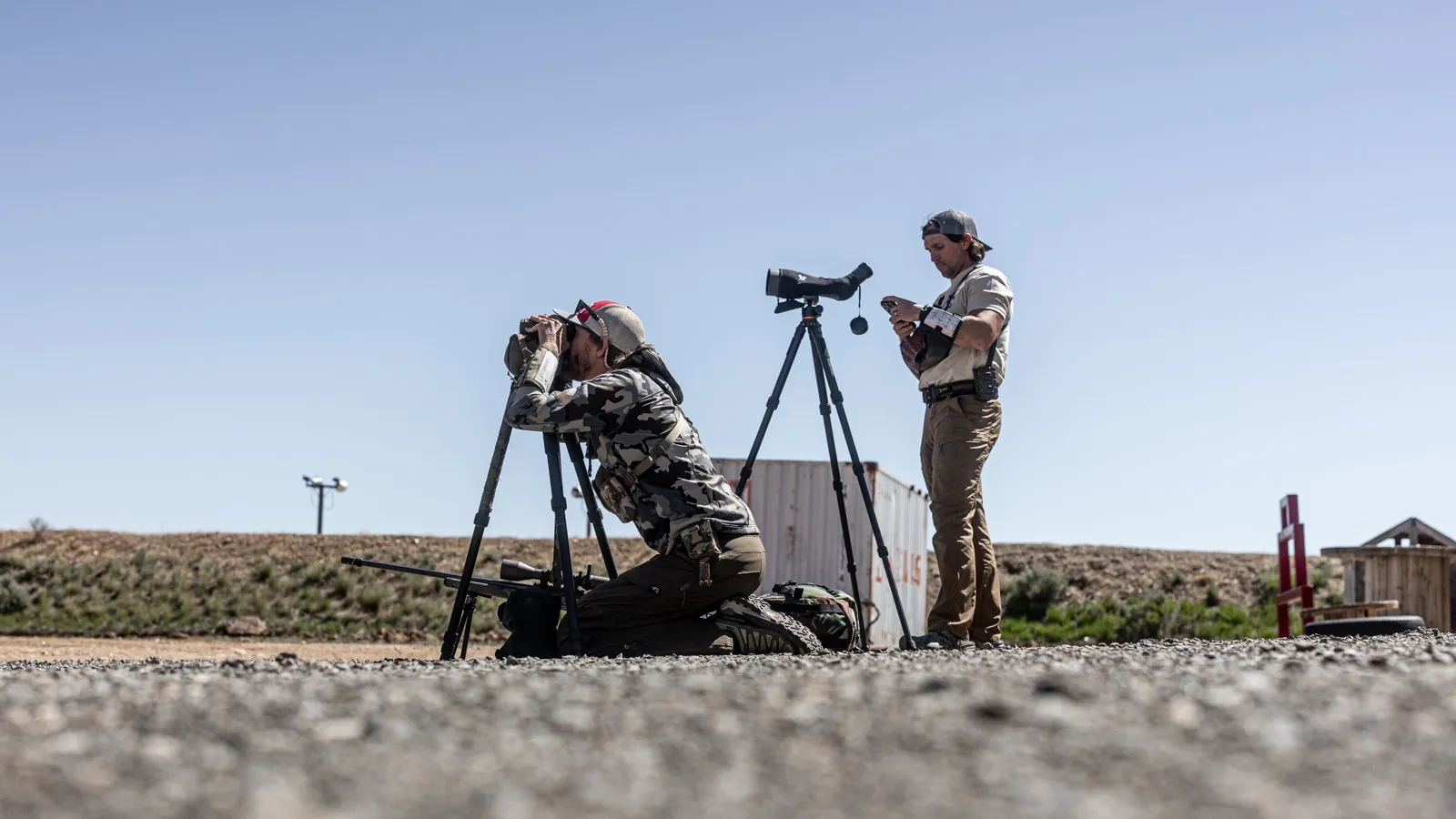
This is the read we walk at a class, step by step. Run it in order. With a partner whenever you can — saying the number out loud forces you to commit instead of dialing on a maybe.
- Identify your target and note its azimuth / direction.
- If using a ballistics app, enter or capture the target azimuth.
- Identify the wind at your position. Determine its direction.
- Can you feel wind on your face?
- Can you see a range flag or vegetation moving?
- Note the wind direction relative to the target.
- Note the wind speed.
- Use a wind meter to help — capture the direction with the device.
- Key in on your surroundings to estimate speed: leaves, bushes, branches, trees.
- Return to the target. Compare wind effects at your position to those at the target.
- Look for mirage, vegetation, flags.
- Are they the same, similar, or different?
- Look to the left and right of your target.
- Any terrain features or buildings that change wind direction at the target — or give false indicators?
- Guess the minimum possible wind speed, then the maximum possible.
- Can you bracket both holds on your target?
- Can you reverse-engineer a previous shot to find the actual downrange wind speed?
- Make your final decision on wind speed and direction at the target.
- Consider the terrain between you and the target.
- Will it affect your bullet's flight?
- Consider your bullet's max ordinate.
- Will the wind be stronger or weaker at that height — and will that affect bullet flight?
- Will this wind direction add crosswind jump or dive to your elevation solution?
- Check your ballistic device.
- Confirm your call with your partner.
- Dial or hold your final decision.
Ballistic solver
Build your wind firing solution in a solver and read the wind drift column — not total drift. Total folds in spin drift and the like; for your wind call you want wind alone. Update it when conditions move.
Personal wind cheat sheet
Generate your drift at your usual distances for set wind speeds (say 5 and 10 mph), lay it out in a table, and laminate it. Now you interpolate and adjust for value in the field instead of leaning on the solver every shot.
Gun Number
The fastest no-reference snap call we teach. Find the one wind speed where your hold lines up to your range — .1 mil at 100, .2 at 200, .3 at 300, and so on. That's your gun number. Now any target's range gives you the hold for that much wind, and you scale from there. It comes off the top of your head — no cheat sheet — which is the whole point.
Learn the Gun Number system →Build the read
Every shot is a data point. Reverse-engineer the wind from where the bullet actually went, log it, and the next read gets tighter. That's the loop that builds a wind caller.
Reverse-engineer the wind
Don't just note where you hit — work backward to the actual downrange wind that produced it. Take yourself out of the scope and ask how the wind is flowing through the terrain to make that impact make sense. If it's clearly blowing 20 but you only held for a few, the angle is cutting it down to a smaller full value. Build the picture, then bank it: "that was a 6-mile-an-hour wind because the grass was blowing, I could feel it, it was loud in my ear."
Keep a wind logbook
Write down the call, the conditions, and the result — hits and misses both. Over time the log turns scattered shots into a baseline you can trust, and the gap between "unknown conditions" and a good call shrinks. New shooters start in 5- or 6-mph brackets; with reps that drops to 4, then 3, then 2. That progression is the intuition people talk about.
The four ways shooters blow the call
Over-weighting the near wind
The wind on your face is the easiest to feel, so it gets too many votes. The air at the target moves the bullet most — weight it accordingly.
Ignoring mid-range changes
A cut in the tree line, a draw, a pond — the wind switches in the middle and you never looked. If your call is right at both ends but the bullet's off, the middle is talking.
Misreading mirage
Mirage tells you direction, speed, and value — but it reads the air close to you, and boiling mirage in a head/tailwind looks like no wind at all. Confirm it against another indicator.
Analysis paralysis
Chasing the wind down to the exact mile per hour freezes you on the gun. Bracket it, pick a number inside, and send. You learn more from a committed miss than a call you never made.
The "sixth sense" is just reps through this list
New shooters freeze trying to name the wind perfectly. You can't, and you don't need to. Find the honest minimum and the honest maximum, pick a number inside, and commit. A committed call you can learn from beats a perfect call you never made — because the next step is watching the impact and tightening the bracket for the shot after.
That's the loop: read, bracket, commit, watch, adjust. Don't be afraid to miss — that's the whole point. We learn more from our misses than from our impacts. Run the system honestly enough times and the "sixth sense" people credit good shooters with turns out to be exactly this — a lot of reps through a process they no longer have to think about.
Precision through chaos. Read it, bracket it, commit.
Stop guessing in the wind
Reading a list only gets you so far. The reps that build a wind caller happen behind the rifle, with an instructor calling it next to you. Come work the system on the range.