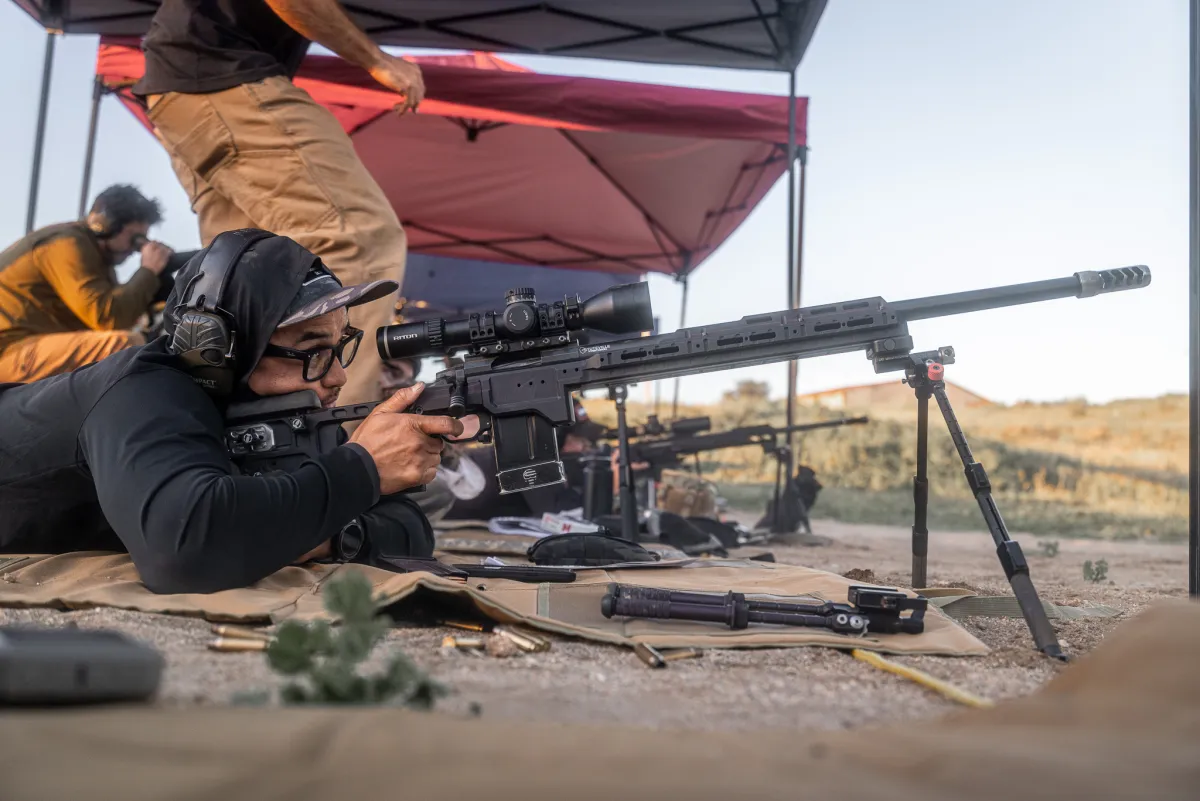
Cadre instructors and students working through the Foundation course on the range

Standards / Foundation

Know Where You Stand

Five events. Twenty points each. One honest benchmark for the skill a shooter should hold after foundational precision rifle training.

A measured answer

Most classes end with a feeling. This ends with a number.

The Cadre Foundation Standard is the benchmark we believe a shooter should be able to hold after a Level 1 or foundational precision rifle course. It is the same standard shot during The Cadre Foundation in-person course.

Run the same five events, score them the same way, and leave with an honest answer: where your skill sits today and what you need to train next.

The Foundation Card

Five events. One progressive test.

The card starts with the mechanical truth of the rifle, adds timed deployment, then moves through known, long known, and unknown distance.

Event 01 · 20 points

Rifle Zero

Establish an honest reference point before anything else.

Distance 100 yards
Full-score budget 20 rounds
Par 15 minutes
Points 20
Task
The shooter zeros the precision rifle system.
Method
At 100 yards, verify the optic mounting, level, and eye relief, then establish and confirm a mechanical zero. Finish with a three-round confirmation group and return the turrets to Elevation 0 and Windage 0.
Purpose
Every firing solution, hold, and correction depends on the zero. This event proves the shooter can establish that reference point instead of assuming it.
End state
The rifle holds a sub-0.75 MOA three-round group whose center is no more than 0.5 MOA from the intended point of aim, with both turrets confirmed at zero.

What counts

  • Three-round confirmation group measures less than 0.75 MOA.
  • Group center is within 0.5 MOA of the intended point of aim.
  • Full 20 points when the standard is confirmed in 20 rounds or fewer.
  • Each additional round required to reach the standard deducts one point.
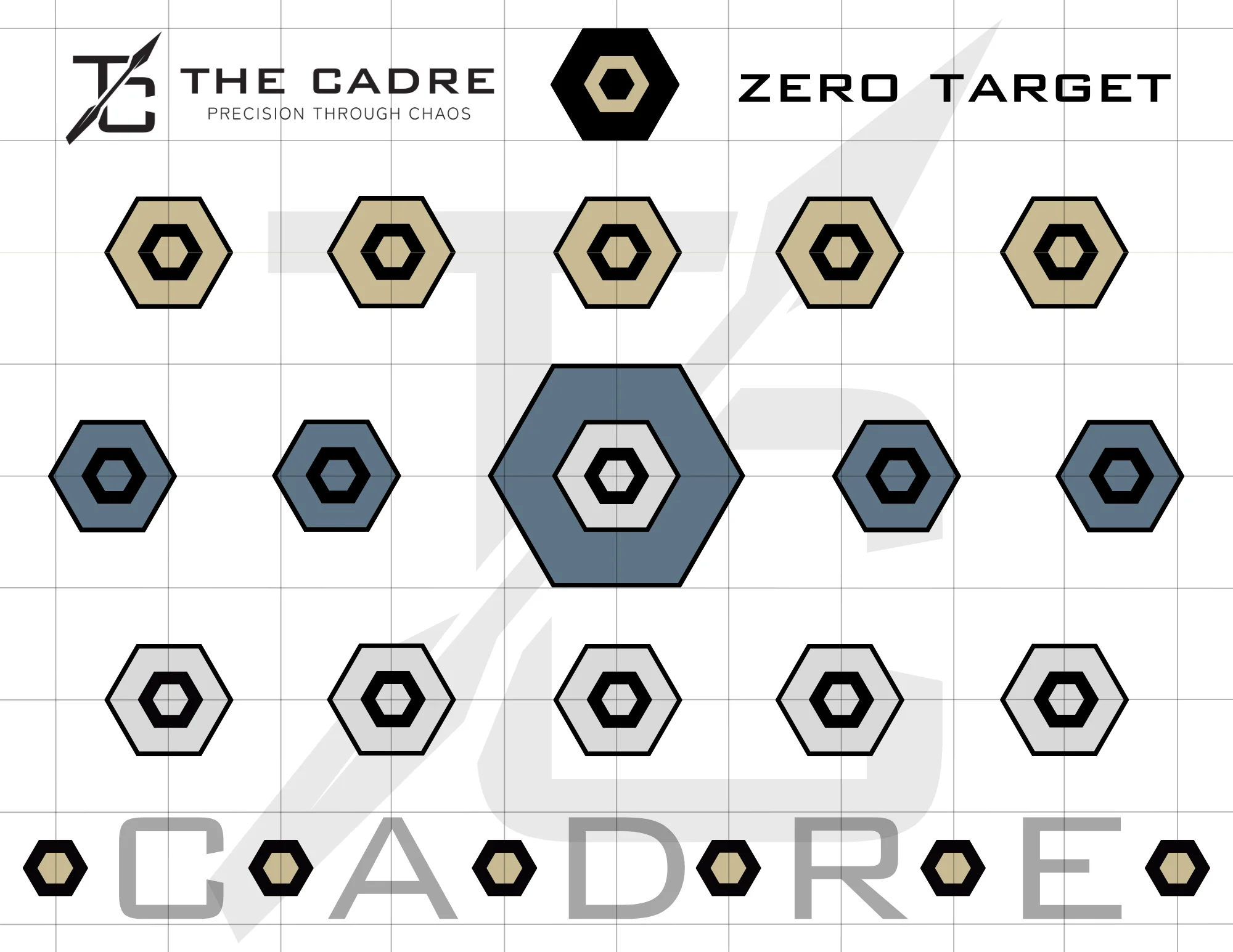
The Cadre zero target with MOA grid and confirmation aiming points
Official target Download print PDF

Submit your results

Record your score and training notes for Rifle Zero.

Event 02 · 20 points

Build and Deploy

Drive the rifle at 100 yards before the environment enters the problem.

Distance 100 yards
Targets 3 MOA + 1 MOA
Rounds 20
Points 20
Task
The shooter completes four timed drills that progress from a clean rifle connection to full rifle deployment and a magazine change.
Method
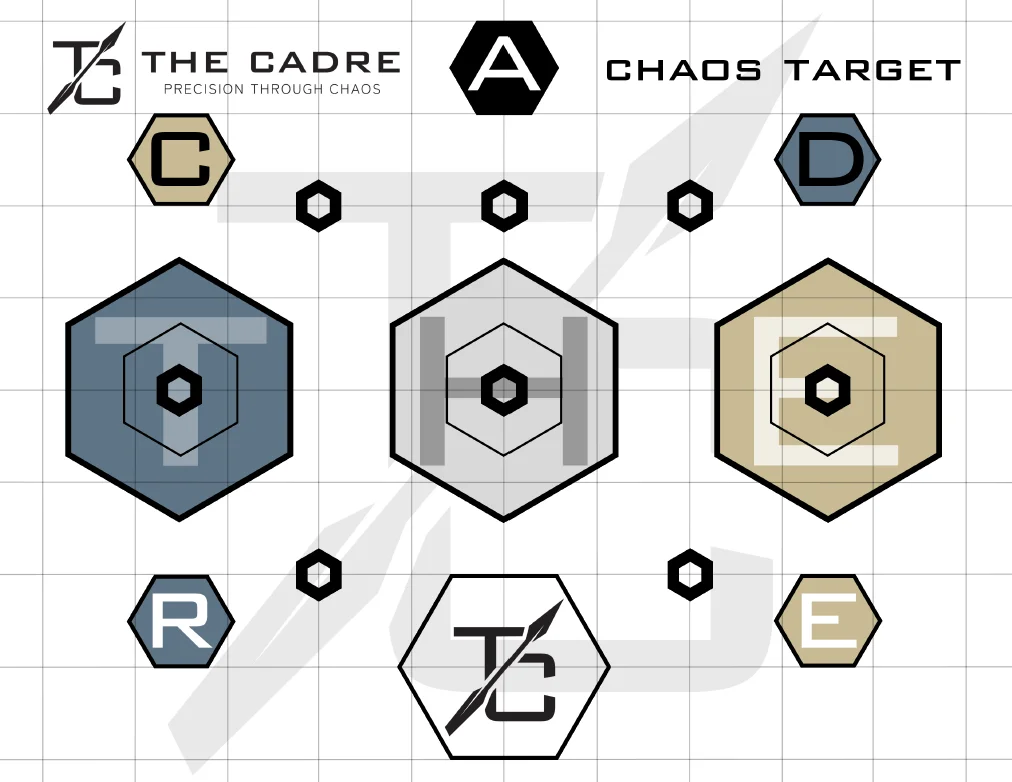
Using a confirmed rifle zero and the Cadre Chaos target at 100 yards, run each drill on command and inside its stated par. Drills one through three are repeated five times. Drill four is one five-round CADRE sequence.
Purpose
This event isolates the shooter’s mechanics: connecting to the rifle, building a stable prone position, deploying equipment, and staying accountable under time.
End state
The shooter completes every build and deployment inside par and records accountable impacts on the designated targets.

What counts

  • Every impact earns one point; a miss earns zero.
  • A line break counts as an impact.
  • A shot outside its par earns zero.
  • An out-of-sequence target in Drill 4 earns zero.
The Cadre Chaos target used for the four Build and Deploy drills
Official target Download print PDF

The four drills

01 10 sec each

No Bag Build and Break

3 MOA · 5 reps

Start prone behind the set rifle. On command, build a high and medial shoulder connection and bridge, then fire one round. No support bag.

02 15 sec each

Standing to Prone

3 MOA · 5 reps

Start standing behind the rifle with the magazine seated and bolt to the rear. Build the prone position and fire one round.

03 25 sec each

Full Rifle Deployment

3 MOA · 5 reps

Start standing with all gear in hand, bipod collapsed and stowed, and support bag in hand. Deploy, build prone, and fire one round.

04 60 sec total

Full Rifle Deployment with Magazine Change

1 MOA · 5 rounds

Deploy from all gear in hand, then engage the labeled targets in order: C, A, D. Reload. R, E.

Submit your results

Record your score and training notes for Build and Deploy.

Event 03 · 20 points

Prone Known Distance

Apply prone mechanics and known data across five targets.

Distance band 300–700 yards*
Targets 5 available steel
Par Under 3 minutes
Points 20

*Push the course out only as far as your range safely allows.

Task
The shooter engages five known-distance steel targets from the prone position.
Method
With target distances disclosed, build a prone position, calculate or confirm the firing solution, dial for each target, and work through the array using the Cadre Engagement and Scoring System.
Purpose
To evaluate basic prone mechanics, data application, dialing, re-engagements, and the shooter’s ability to correct from observed impacts.
End state
The shooter produces an accountable 20-point score across five targets, keeps impacts within a 2 MOA area, and maintains a repeatable prone position with correct firing solutions.

What counts

  • Engage five targets using the Cadre distance-event scoring system.
  • Complete the full target array in under three minutes.
  • Use whatever target sizes the range has available; the performance goal is to keep impacts inside a 2 MOA area.
  • Up to three attempts are available to establish the first impact.
  • After any impact, fire the required follow-up shot.
  • A clean run uses 10 rounds; the event can require up to 20.
Far Near
Firing line
Target type IPSC silhouette Impact radius 2 MOA goal
Course of fire · targets progress from near to far Engagement order: 1 → 2 → 3 → 4 → 5 IPSC silhouettes are shown here. The round target with the top tab is a much smaller target and is not shown in these examples. Depth is illustrative; use the target sizes available at your range.

Submit your results

Record your score and training notes for Prone Known Distance.

Event 04 · 20 points

Prone Long Known Distance

Stretch the rifle system and prove the data holds.

Distance band 700–1,200 yards*
Targets 5 available steel
Par Under 4 minutes
Points 20

*Push the course out only as far as your range safely allows.

Task
The shooter engages five long-range, known-distance steel targets from prone.
Method
Using confirmed ballistic data, build the prone position, solve and dial for each disclosed distance, then engage the array under the Cadre Engagement and Scoring System.
Purpose
To test the shooter’s understanding of rifle data and the ability to apply it when small errors become visible at long range.
End state
The shooter records an accountable 20-point score, keeps impacts within a 2 MOA area, and demonstrates that the rifle profile, firing solutions, and corrections remain trustworthy at distance.

What counts

  • Engage five targets using the Cadre distance-event scoring system.
  • Complete the full target array in under four minutes.
  • Use whatever target sizes the range has available; the performance goal is to keep impacts inside a 2 MOA area.
  • Use confirmed data and a deliberate wind process on every target.
  • After any impact, fire the required follow-up shot.
  • Record the firing solution, wind call, result, points, and notes.
Far Near
Firing line
Target type IPSC silhouette Impact radius 2 MOA goal
Long-distance course of fire · targets progress from near to far Engagement order: 1 → 2 → 3 → 4 → 5 IPSC silhouettes are shown here. The round target with the top tab is a much smaller target and is not shown in these examples. Depth is illustrative; use the target sizes available at your range.

Submit your results

Record your score and training notes for Prone Long Known Distance.

Event 05 · 20 points

Prone Unknown Distance

Find the range, build the solution, and deliver.

Distance band 300–700 yards
Targets 5 available steel
Range Withheld
Par Under 5 minutes
Points 20
Task
The shooter engages five steel targets at undisclosed distances from prone.
Method
Identify and range each target, build the ballistic solution, apply the wind call, and engage the randomized array using the Cadre Engagement and Scoring System.
Purpose
To test practical field shooting when the range is not supplied and the shooter must create the firing solution before making the shot.
End state
The shooter records an accountable 20-point score, keeps impacts within a 2 MOA area, and demonstrates reliable ranging, solution building, target management, and corrections.

What counts

  • Range and solve five targets before or during the course of fire.
  • Complete the full randomized array in under five minutes.
  • Use whatever target sizes the range has available; the performance goal is to keep impacts inside a 2 MOA area.
  • Engage the targets in the designated randomized order.
  • After any impact, fire the required follow-up shot.
  • Record range, solution, wind call, result, points, and notes.
Far Near
Firing line
Target type IPSC silhouette Impact radius 2 MOA goal
Unknown-distance course of fire · targets shown at different depths Example randomized engagement order: 1 → 3 → 5 → 4 → 2 IPSC silhouettes are shown here. The round target with the top tab is a much smaller target and is not shown in these examples. Depth is illustrative; use the target sizes available at your range.

Submit your results

Record your score and training notes for Prone Unknown Distance.

Read this before Events 3–5

The Cadre Engagement and Scoring System

Every distance event uses five targets worth four points each. The earlier the first impact, the more it is worth. Any impact must be followed by one more shot.

20 points per event
First-round impact 3 pts
Second-round impact 2 pts
Third-round impact 1 pt
Required follow-up impact +1 pt
No impact in three rounds 0 · F
5 targets × 4 points 20

Why the follow-up?

The purpose changes with the shooter.

For competitors, the follow-up proves the shooter can apply the correction, bring the reticle back to center, and deliver again. For hunters and military personnel, the purpose is to continue follow-up shots until the desired result downrange is achieved.

Why up to three shots?

The score has to survive real conditions.

Not all ranges are equal. Terrain, shifting wind, and changing vertical can make a good first-round call hard to hold. Three attempts let the shooter read the day and still be measured honestly. A 10 in violent wind can represent better shooting than a 20 in calm conditions.

Run it two ways

Shoot it on your own—or shoot it at a course.

When you run the standard on your own, record the conditions and follow the same process every time. At a Cadre course, our instructors shoot the distance event first. Their score establishes what the range and conditions are giving that day—it is context, not a ceiling.

Available now

The official setup guide and Foundation scorecard.

The four-page PDF includes every event, setup requirements, the engagement and scoring system, and a printable scorecard for recording your results.

Run it on your range

Bring the full system, not just the rifle.

A useful benchmark depends on consistent setup, enough ammunition, honest data, and a record of the conditions.

Required

  • Precision rifle and bipod
  • Support bag
  • Approximately 100 rounds
  • Two magazines
  • Zero target and Cadre Chaos target
  • Timer and laser rangefinder
  • Scorecard, setup notes, and writing gear
  • Ballistic solver or validated data card

Shoot the same standard with us

Build the foundation. Then prove it.

The Foundation course teaches the mechanics, data, and wind process behind the card, then gives you the range time and coaching to run it honestly.